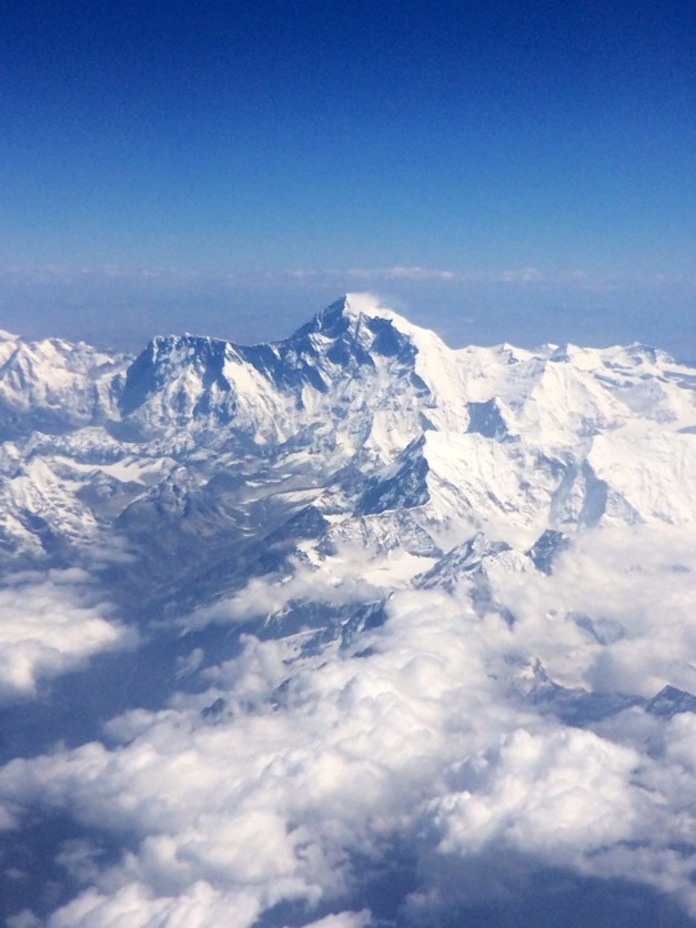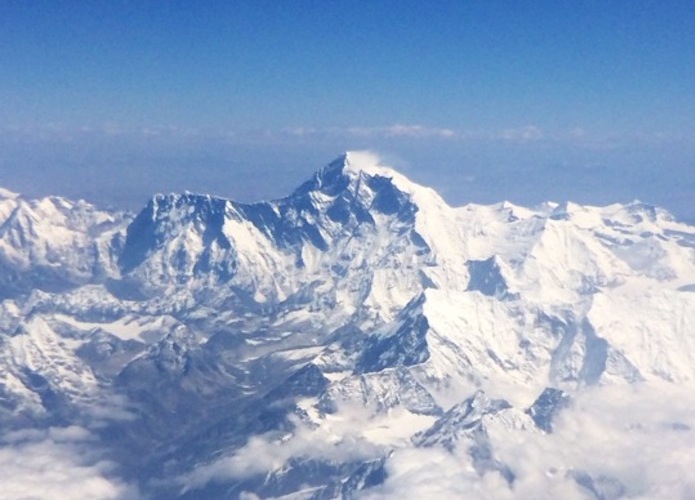
Diving into Paro like an eagle, banking right…swooping left. Mountains on either side, foothills peeking in the window of the plane. Gripping my armrests the entire landing sequence, I feel the blood rush up my chest to my neck and cheeks. I’ve flown enough that it was not the scariest flight I have taken (see Lukla), but for whatever reason on this particular day, as the pilot made his final maneuvers through the hilly pass, it felt like it would be my last.
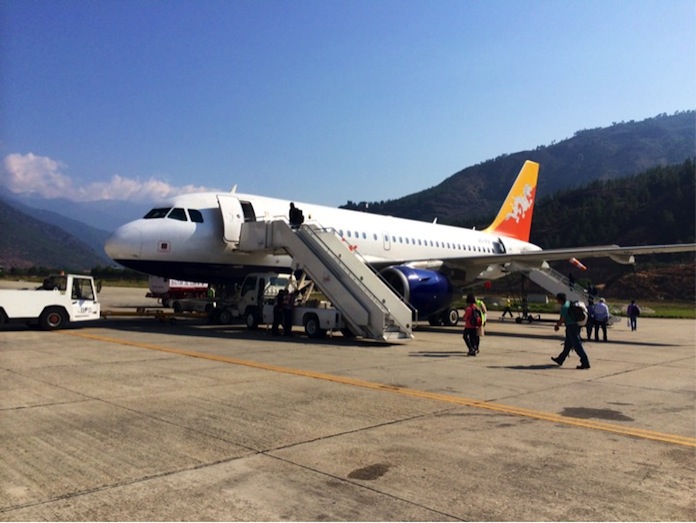
I was assured by my friends and guide that Bhutanese pilots are the best and most sought after pilots. As a matter of fact, all non-Bhutanese pilots are banned from flying into Bhutan after an incident where a foreign pilot nearly mistook the expressway for a runway. From then on, the King decreed all pilots flying into Bhutan, must be from Bhutan. Occasionally, we pass signs on the roadway, (perhaps to remind an errant pilot) “This is a Highway, Not an Airstrip”.
The first thing I notice about Bhutan is the beauty of the land. It is like Nepal—mountainous and hilly, with valleys and rivers, but much less populated and defiled by pollution and sprawl. The people are homogenous in all aspects of their culture, although with the small opening of global influence that is now occurring, it will be interesting to see what the next 20 years hold. From all accounts during my
brief tour of this Himalayan jewel, the country as it stands today, with its dress, architecture, language and other general cultural identity spawns from the 1600s. That is when a Militant Monk fleeing religious persecution from Tibet united the kingdom under a singular rule. But that’s what Wikipedia is for, isn’t it?
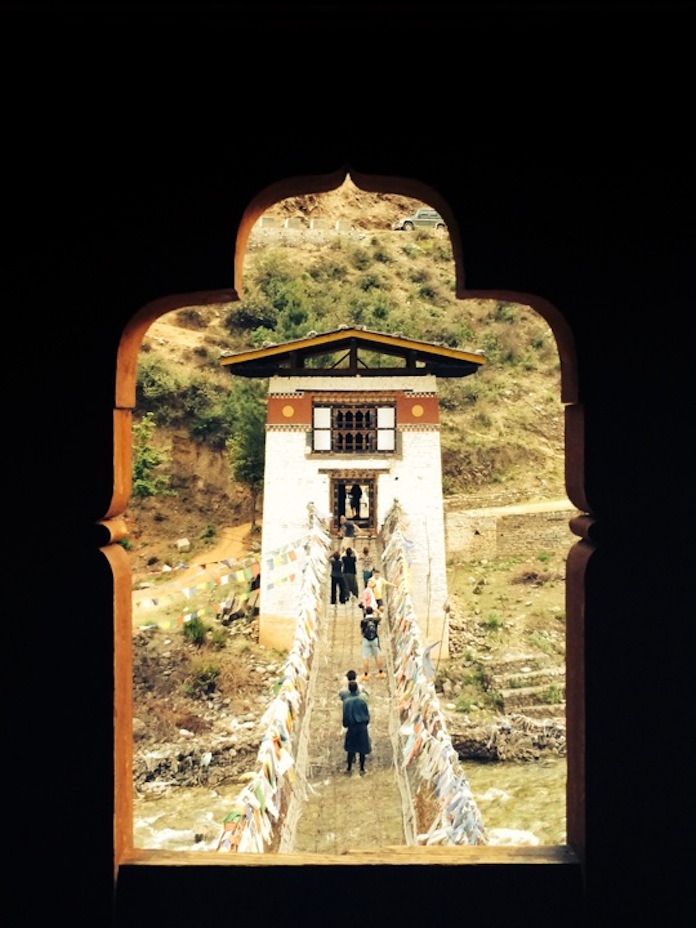
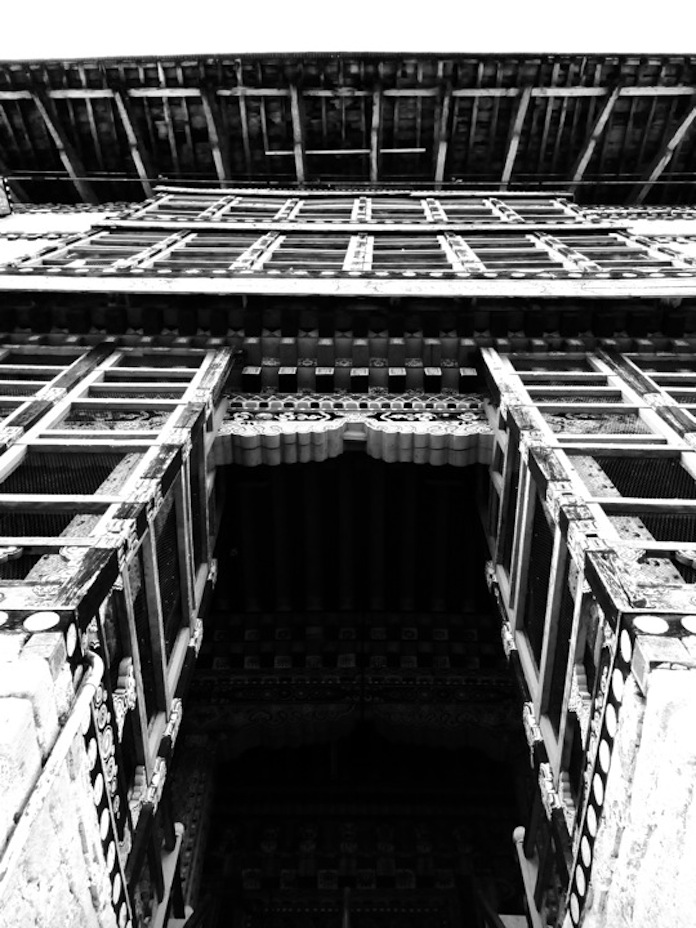
Onward to Thimpu, the capital city. This is the place where all government and religious activities take place and are carried out by K5 (the current fifth king), Prime Minister, and Je Khenpo (the chosen religious leader). You can find them around the Dzong, the 17th century architectural complex that houses both authorities’ offices.
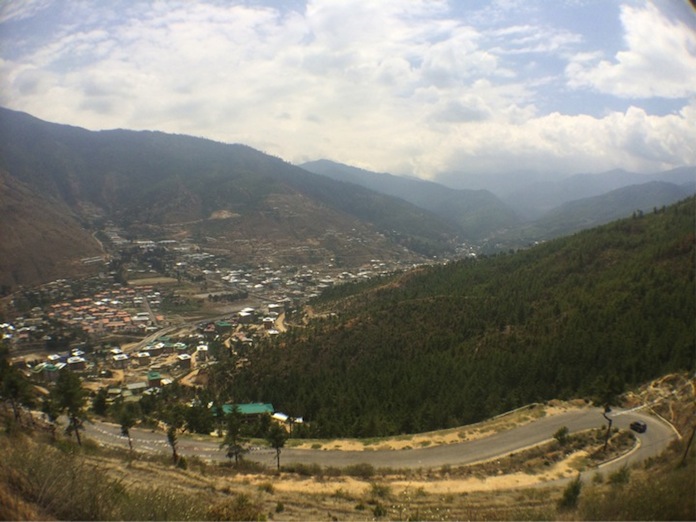
Thimpu is small, and beginning to show subtle signs of a tidy sprawl. It is a young-feeling city, as many of the youth from the villages are giving up traditional farming roles, and looking for greater enterprise in the city. I can relate, but there is a certain sadness in seeing a way of life abandoned in favor of the conveniences of the modern world.
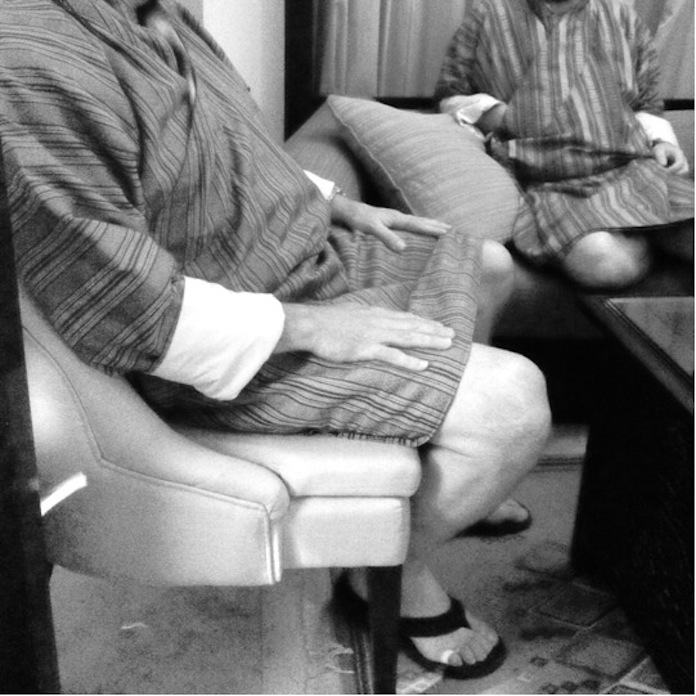
Fear not, the traditional dress (the gho for men, and kira for women) are still commonly worn, although no longer required. We were lucky enough to be part of a cultural program at our hotel. They asked that we wear the clothing for the evening. What happens when a couple of middle-age, white, American men put on robes as formal wear and start roaming the grounds of a five star hotel? Two words: Basic Instinct. OK, one more word: Embarrassment (but for whom is the question).
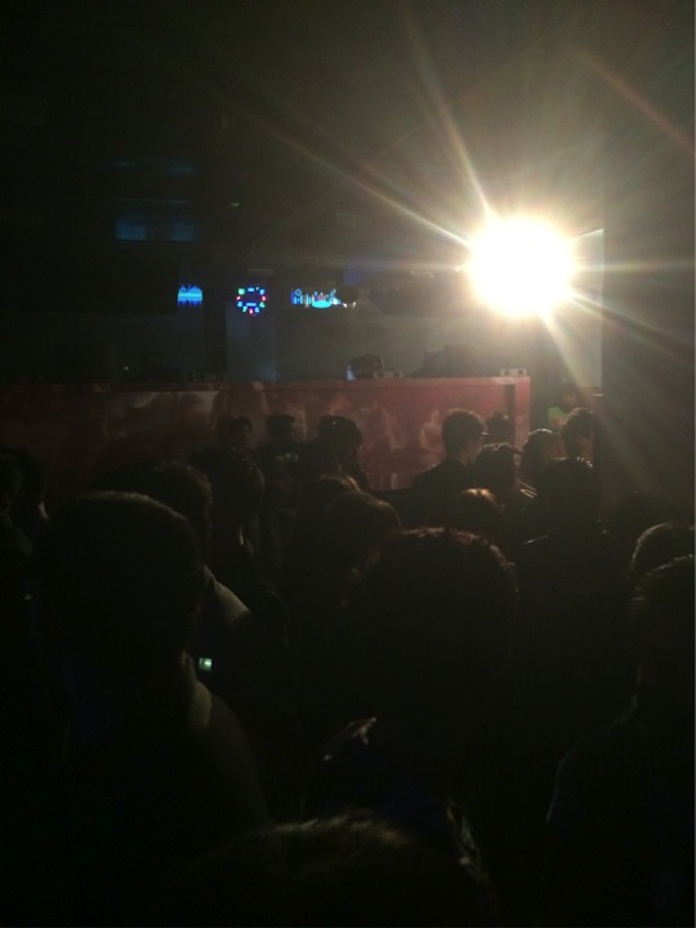
So bring on the night. Our group enjoyed a traditional dinner served with a native Bhutanese pink rice, and spicy chilly and cheese dishes. Nightlife in the capital was existent, but subdued by the mellow vibe that seems to permeate the entire land. Then again, drunk girls will cry and shout, and drunk boys will rage about. Club music, wherever in the world, keeps people moving late into the night.
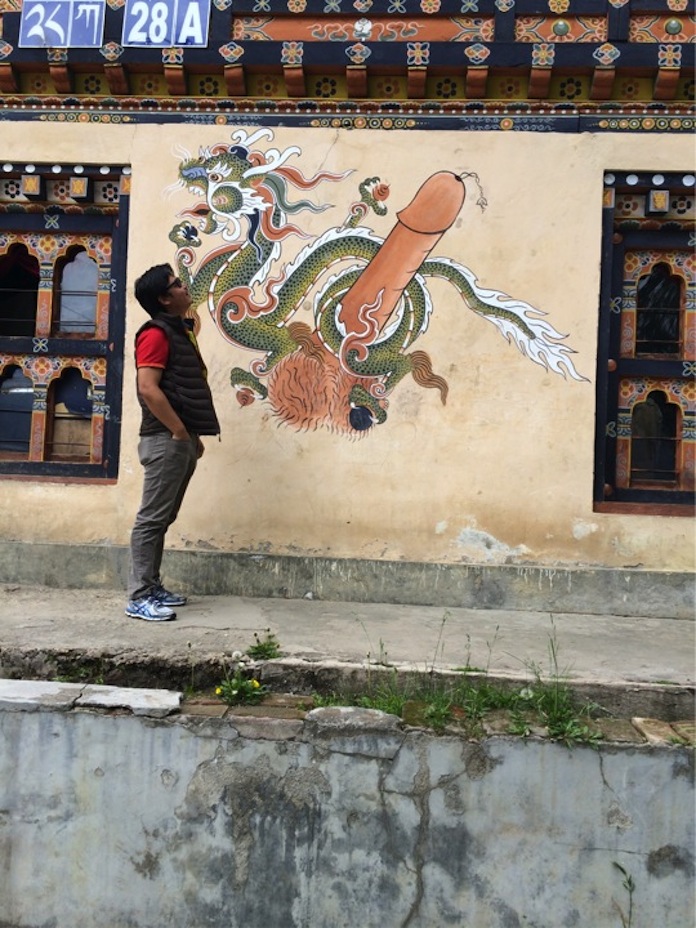
A brief side note: Somewhere along the way, someone decided it was good luck to paint penises on the wall to scare away evil spirits. Then they got the idea that maybe wearing a mask with a phallus protruding from the forehead was a good idea. Then in all the tourist shops, among the paintings and textiles, there they are…wooden dongs of every size. Some are flaming and spitting. Some are smiling.
Some are attached to key chains.
Back to Paro, home to Tiger’s Nest, a monastery precipitously perched midway up the ledge of a rock face (and by face, it does actually look like a face). So the hike goes…up. And up. And up. Then a little down. Then more up. Sweating. Huffing. Trying to avoid the horse manure littering the trail. But I do the walk no justice, because it was beautiful. My Tibetan friend laughed and said, “I don’t know why people trek. It isn’t fun.” Im not sure why, but this was hysterical to me, but laughter used too much energy…and on we went. Through the pines and then…down, down down, and up, up up. Repeat a few more times, and we were there. Photographs are the only way to describe this mystical place where Guru Rinpoche flew in the belly of his consort, who took the form of a flying tiger over the mountains, in order for him to defeat and transform the evil spirits causing harm to the people below into protectors of the dharma. Only pictures can describe the cave where he meditated for 3 years, 3 months, 3 weeks, and 3 days—or the golden doors that house the talking Buddha statue. Imagining the view without seeing the image is impossible. However, security took my camera at the entrance, so just trust me on
this one.
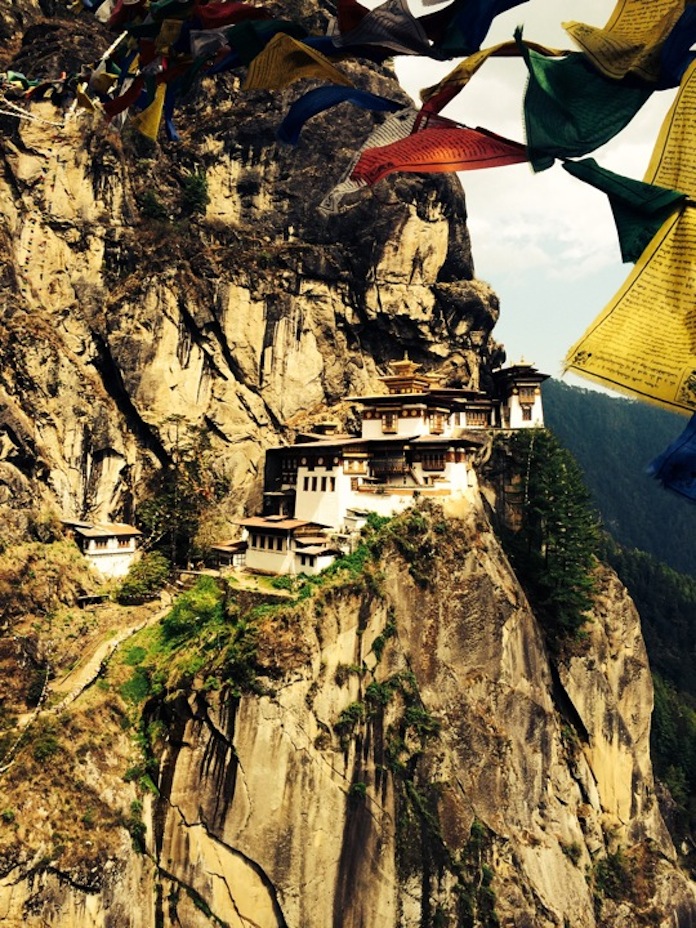
And trust me that no matter what they say, down is easier than up…but up is more rewarding when you get to the top