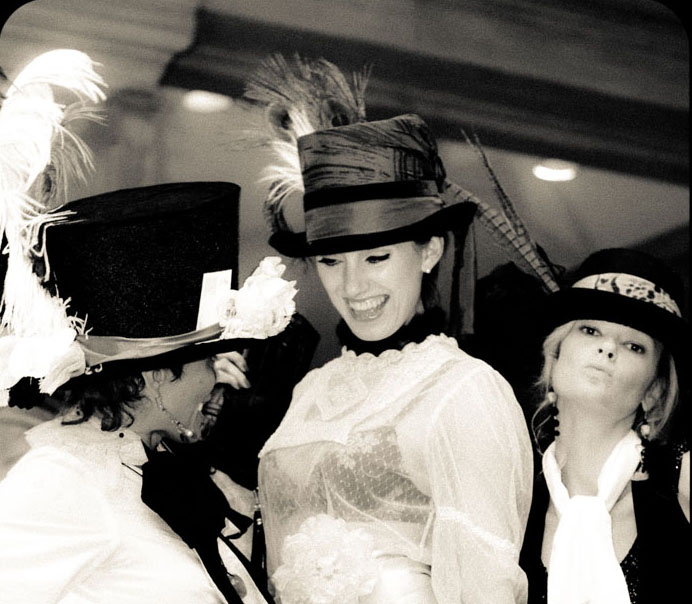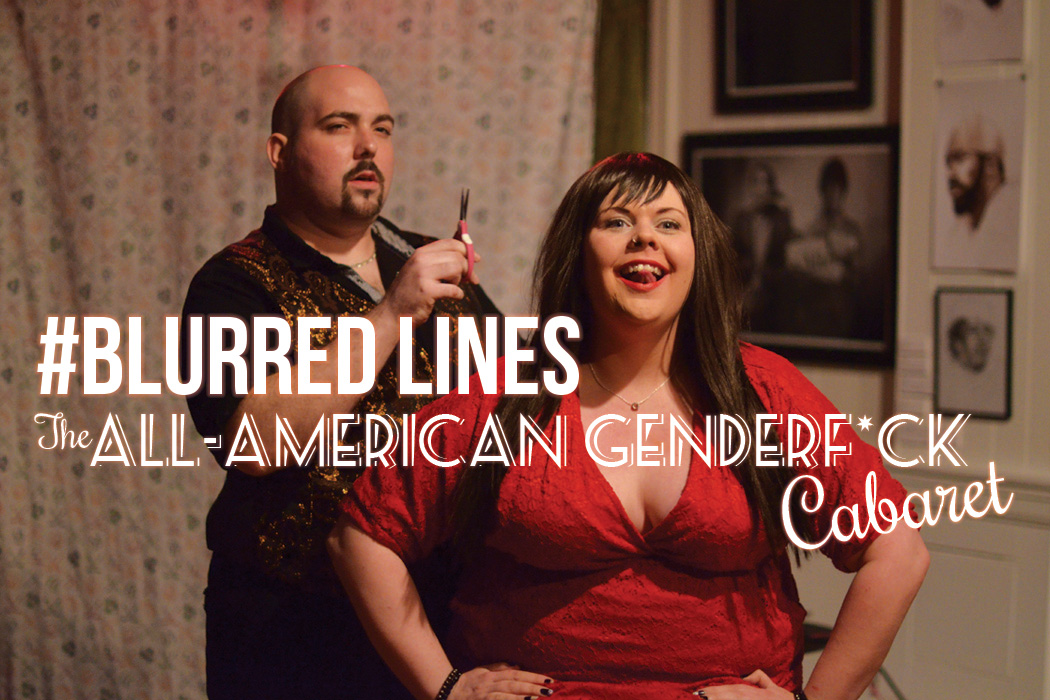
When The All-American Genderf*ck Cabaret begins, androgynous MC Taylor invites audience members to “fuck some gender,” and then explains how they probably already did sometime today. Female audience members probably did something typically masculine, and liked it; male audience members did something feminine, probably in secret, and were tickled pink. Taylor is delighted by that fact, as well as the fact that their personal appearance and costuming deyny the audience members the ability to assign them male or female pronouns– clad with button-down shirt, vest, and tie, as well as short shorts and garters. Taylor fucks gender every day, which makes them the perfect person to take the audience on a journey through the lives of Genderf*ck’s eight other characters.
Genderf*ck is composed of eight characters who start out as utter stereotypes but evolve, through dramatic monologues, swift, smart comedy, and ensemble dance numbers, into real human beings, culminating with the revelation that aside from their own personal identities, they all have the ability to genderf*ck. Playwright Mariah MacCarthy said that, “I think many of these characters are different aspects of me. I have definitely been [promiscuous woman] Gwen. I have definitely been [masculine straight woman] Devon. I’ve certainly been [masculine straight man] Dick, and [feminine straight man] Benji. Some characters were easier to inhabit than others, and some characters get more stage time than others. That’s the way it goes. Genderf*cking is a messy business.”
However, in her words, the play is not necessarily exactly about gender: it’s about how our gender is expressed with regards to “people we’d maybe like to get naked with. That intersection interests me because I think gender and sex are essentially about power. We equate femininity with vulnerability and masculinity with strength, even though vulnerability IS strength–and grappling with one’s sexuality in any kind of meaningful way requires vulnerability. I think vulnerability is terrifying, and I’m interested in things that are terrifying.” Many of the characters find themselves having to come to grips with the ways that their gender and sexuality make them vulnerable to others, either when facing an attraction they did not expect or discovering new and darker corners of their sexuality.
Many of the actors also found themselves in roles that they did not expect. Sarah Weissman, Glass Mind Theatre’s marketing director, plays Devon, the masculine straight woman. “It’s funny, I knew I wanted to be in it but I thought I would get cast as the stereotypically girly girl [Allegra]. I think I kind of put limitations on myself,” Weissman said. Playing Devon made her stretch into modes of behavior and expression that she doesn’t necessarily inhabit ordinarily: “I am not what you’d call athletic, and she’s actually a personal trainer, so that’s unfamiliar… I actually just started working out more, and it’s so funny because I’m sort of academic – I like words and I like to think, and I like to ponder things, and I’m a writer, and she is so in her body.”
Director Susan Stroupe assisted her actors with reaching new places within themselves in order to play characters they may not have expected to be playing, especially with regards to the stereotypes that each character begins as: “We’re taught not to be stereotypical, because stereotypes are so terrible, we can’t talk about them, we can’t touch them, we can’t do anything with them, so peeling off all of those layers was so much fun. It’s okay to [be stereotypical] right now because we’re going on this journey, but we have to start from a place that’s so big that we have a place to go,” Stroupe said. While many of the actors expressed nervousness about playing so far into stereotypes, she told them to “go as far as you can and we’ll pull you back if we must.” But while the stereotypes early in the show are hysterical, most important is the journey they all get to go on: “It’s really exciting to be so huge and stereotypical and then get so real, because everyone gets at least a moment to be real, and that contrast is really fun,” Weissman said.

Glass Mind Theatre’s production of Genderf*ck is the show’s first time in Baltimore, and as Stroupe said, there is something very Baltimorean about the play, despite its beginnings in New York: “It’s a really complex city. The identity of the city is really complex, and I still don’t think that I have a full grasp of how to describe Baltimore to someone… I think it’s become very popular to label things in a way that forms your identity. And I think with Baltimore it’s that struggle of, is there a right label for this? And I think that’s part of the message of the play, is that you’re welcome to use labels to help you, but knowing that that may not embrace the full texture and the full complexity of the situation. And I think people in Baltimore might be able to relate to that.”
Androgynous MC Taylor guides each of the characters along that journey of identification, interacting with them and the audience, delivering asides and small but highly relevant bits of backstory about the characters and the action as it goes on – sometimes even holding up their hand and stopping everything dead to narrate. Taylor can even invite the audience – and other characters – into their fellow characters’ dreams. And yet, towards the end of the show, Taylor finds themself getting just as swept up in the story as the rest.
One of the challenges for actor M. Hicks was finding the balance between the reality and unreality that Taylor embodies: “That was one of the more difficult aspects of it, because it’s this push and pull between there’s this very realistic facet of this person, and that’s like the real person that most of us know and has very trying experiences, and then there’s this completely stereotypical, archetypical character of the cabaret MC. It took a lot of negotiating to figure out how we were going to balance this archetype of the androgynous MC and this very real person who lives in a contemporary world and has real complicated feelings and interactions.” The MC role is a complicated role for Taylor, one that we see them both enjoying heartily and finding troubling: “My perception of Taylor is that they are at times unwilling to fill that MC role; it feels obligatory and people kind of pigeonhole them into it, because they’re an androgynous person,” Hicks said.
At one point Taylor’s gender is discussed, in the form of a dance sequence prompted by masculine lesbian Kate. The actors dance around to “The Name Game” and a Postmodern Jukebox cover of “Blurred Lines,” flinging clothes wildly and giddily at one another. It’s a joyful moment – and yet Taylor rejects it. Hicks said that, “The genderfuck dance, as it happens, seems so well-intentioned coming from Kate, but not to oversimplify it reminds me of the trope of the manic pixie dream girl. You encapsulate all of these magical fantastical things that I can’t make for myself! And that disempowers the person themselves from having any agency.”
At the end of the play, each character will have learned something about their relationship to gender, sexuality, themselves, and others, and hopefully the audience will too. MacCarthy is reluctant to call it an epiphany: “Epiphanies can feel forced. You kind of just have to ask yourself, Well, do I believe that this character has learned anything? And be willing to call bullshit on yourself. The fact that some of this play takes place in a magical not-quite-reality makes it a little easier. Things can happen in dreamland that affect the real world.” And yet audience members may leave the show touched by the stories of Taylor, Kate, Gwen, Benji, Dick, Devon, Adrian, Allegra, and DJ, and ready to do some genderfucking of their own.