
Photo by Ben Gest I felt disembodied, as if I were floating, watching people react to the news of my own death. I got this feeling from “Commissure,” The Contemporary Museum’s exhibition of Ben Gest’s extremely large digital photographs, which has been extended until January 30. Over the last couple months, I have returned again and again to the museum in order to try to figure out this sensation. After a while, I got some ideas. All of the portraits depict people who look both devastated and distracted, lost in some moment. Often their eyes are red, their skin pale, as they go through the motions of everyday life, making burgers, climbing steps, sitting on the couch, or doing laundry. All of this is due to the juxtaposition of the photographs together. The same faces recur again and again and the viewer wants to create a story that fits all of these people together. But I came to see the feeling I had experienced was not narratological, but aesthetic, and perhaps even neurological, when the Contemporary extended the Gest show until the end of the month, and the artist got the opportunity to visit the gallery again.
Photo by Ben Gest, story byBaynard Woods.

Photo by Ben Gest Before I met Gest, I had already recognized the most peculiar thing about these portraits. I knew that Gest did not use a single digital exposure, but crafted the pictures from dozens of similar photographs and that this did something bizarre to the perspective in the manner of Velasquez’s “Las Meninas.” But, looking at the pictures with Gest, I came to see what was really happening. Late last Friday, when he arrived to town from New York, we walked through the galleries, talking. Gest entertained my theory about death. He said, “These pictures were done over eight years. The thing that connects them is… Well, let’s start with this one.” He brought me over to a picture of a man and a woman (his parents it turned out) lying in bed. The woman, on one side, had her arm over her hand against the light coming from the television that the man is vaguely watching television. “There’s this intimacy, they’re lying in bed together, but they are doing something contradictory. There is always this part that can’t connect, even in the most intimate moments. There’s a part of you that you don’t share, but you’re still part of something bigger.”

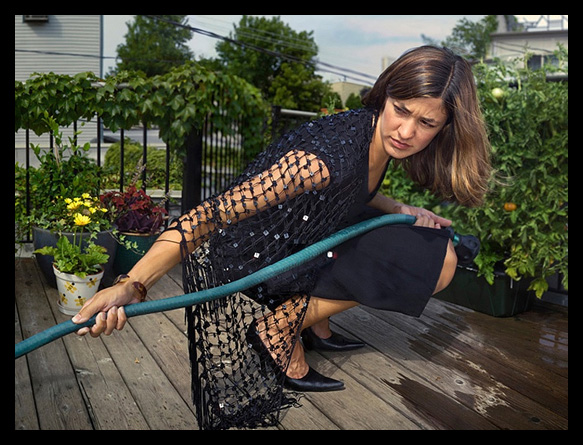
He walked me over to “Jennifer in her Rooftop Garden” (2006). “There is this sort of status moment, because of her clothes and a sense of frustration that comes from a disjunction of who you know yourself to be and the way you present yourself. But in a photograph, it has always been chained to this particular spot, the perspective of the photographer. “But what I did, I took the picture of her hand at a completely different time than the one I took of her face. That’s why the picture is focused both on her hand, her face, the hose. All of these are composed of numerous different photographs. It removes the perspective of the photographer, because the perspective is really coming from seven or eight different spots, but it also allowed me to coach her on one thing at a time. OK, squint your brow. Then later, I could say, ‘Squeeze your hand like this.'”

He took me back to the picture of his parents lying in bed. “It was very bright when I photographed them. The TV wasn’t on. I added all of that shadow and the color and the glow. In this one,” he said, darting again across the room to a painting “Ben and Dawn” (2009). “I painted these with the computer. I made his skin pale. Her eyes, see how they’re red there. I added that.” We stared at the picture a moment. “I didn’t even take the pictures of them together. I took his picture many days before. Then I knew what I wanted her to be doing, once I had worked with his.” “So they really were alone?” “Yeah. But they were still part of that larger thing. One thing I’ve always wanted to talk about is how these are, many of them, commissioned portraits.”

He walked me over to a picture of his mother in a black raincoat walking on the beach, away from the water. “Mom on the Beach in Belmar” (2006). “Look at her shoes in the sand. The only way I could get those so clear, while also having it where you can kind of see up into her hood is to take the picture of her shoes from way up high looking down and to get down low and look up for her face and the hood.” That was the disembodied feeling! There was no perspective. I looked at it later with painter Chris Shaeffer. He was impressed, but said “It gave me a headache after a while, because my eyes couldn’t rest.” This is, in fact, much of Gest’s purpose in using this technique. I asked if he was responding to David Hockney’s quip that “Photography is all right if you don’t mind looking at the world from the point of view of a paralyzed Cyclops– for a split second.” “Very much,” he said. “Hockney’s Polaroids, though, were all about the technique.” Gest was referring to Hockney’s photographic collage series in which he tried to use photographs to allow the eye to capture people in glances, as we actually see them. Like Hockney, Gest performs a kind of photographic Cubism that dissolves the difference between fore and background. Everything is in focus. But it is only a means to an end for Gest. “Hockney left the borders in to emphasize technique. I want to hide that technique to create the illusion that the person is in a very private very intimate moment. But I do so many other things to the pictures.”

“This was a commissioned portrait and first I did his picture and then another and I did each person individually. The only say they got, the only thing they asked, was that the dogs be included.” This was precisely the picture that had been so haunting. It was even more so now. Photo by Ben Gest, story by Baynard Woods.