
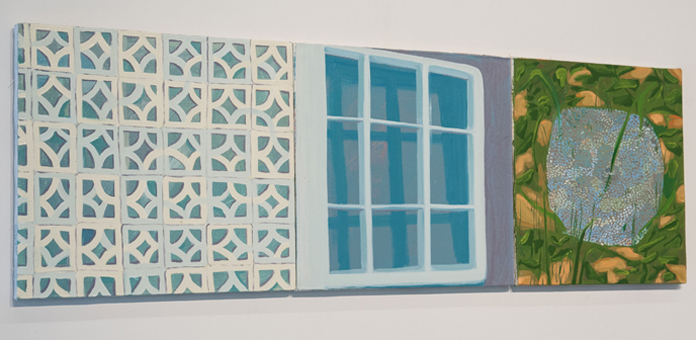
Mary Anne Arntzen, New Friend (Left) and View Finder (Right), 2012, Photograph by Matthew Fishel, courtesy of ICA
See Through, Presented by Institute of Contemporary Art Baltimore and D Center Baltimore, 16 W. North Avenue, Baltimore, MD, January 5 – 27, 2013
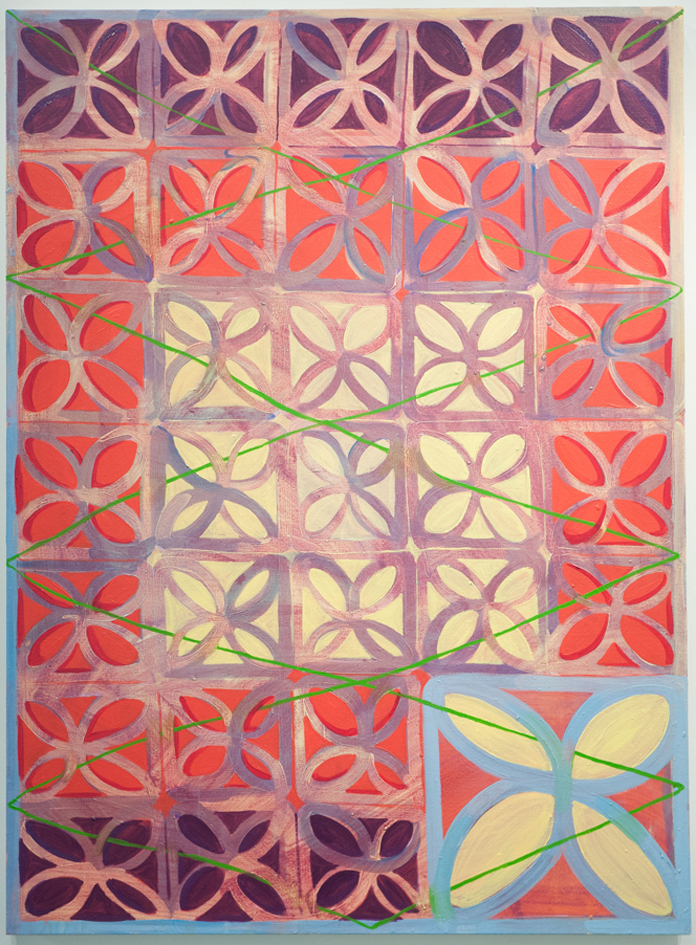
For her first solo show in Baltimore, See Through, Mary Anne Arntzen presents a selection of new paintings that expand on a theme the artist started while working on her MFA at Maryland Institute College of Art. In 2010, Arntzen began painting chain link fences filled-in with pockets of snow. Attracted to the way that the ephemeral veils of snow impacted the geometry of the chain link, she made canvases that captured the white, blue, and grey patterns produced by these wintery cityscapes. Since then, Arntzen has continued painting fences, but also other artificial barriers, such as wooden and concrete lattices. Arntzen’s color palette has grown to be less about pictorial representation and more about the creation of visual vibrations and movement.
Mary Anne Arntzen, Two Explorers, 2012, Photograph by Theresa Keil
When asked if her paintings are abstract, Arntzen responds that for her they are tied to a mental image of whatever scenery initially inspired the work, though it is not necessary to read them as coming from a particular place.
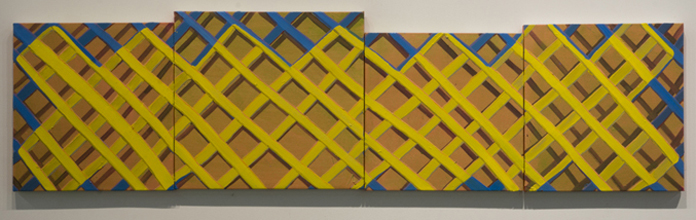
Mary Anne Arntzen, Bang, Bang, Bang, 2012, Photograph by Matthew Fishel courtesy ICA
The artist often paints fences, lattices and grates that she sees on walks around Baltimore, working only from memory on the final product. Some of the paintings in See Through stand out more obviously as signifiers for things in the world. Bang Bang Bang consists of four canvases of different sizes aligned in a row with a continuous pattern of bright yellow and blue latticework connecting their surfaces. Undulating bands of muted red, yellow and blue tones imply shadows behind this frontmost layer. Progressing from the left, these shadows start out staggered from the brighter yellow bands, become thin and contiguous with the yellow bands in the center, and move to stagger with them again on the right side. Details like these shadows demonstrate Arntzen’s skill with regard to realism, as much as she may choose to twist it. Although the range of color conveys a clear sense of play and experimentation, the space created through these implied shadows is clear. It appears as if a fence sags or juts out at an angle in those irregular bands of darker color, or as if Arntzen’s point of view is askew or even in motion.

Detail of New Friend and View Finder, Photograph by Theresa Keil
In other paintings, such as New Friend and View Finder (whose dynamic pairing is one of the nicest moments in the show), Artntzen seems to take more pleasure in distorting the basic diagonal geometries present in her work since 2010. In New Friend, the shapes do not neatly overlap, but break a variety of framing barriers. There is still a sense of foreground and background, but the angles and colors are even more extreme. In View Finder, the mottled texturing present in many of Arntzen’s paintings creates additional depth. The artist prefers to paint while the medium is tacky, so that additional coats of paint pull and resist even application. Arntzen’s work connects to wider trends in Baltimore and beyond. A full resurgence of interest in abstract painting has been in evidence for some time in galleries coast to coast. This new group of abstract painters is quite different from Abstract Expressionists of the mid-century 20th century like Mark Rothko and Clyfford Still. What marks these younger artists in particular is a clear pleasure in the act of making and a resistance to the sometimes self-seriousness and preciosity of their forebears’ output. Paintings progress toward other paintings, rather than in pursuit of spiritual or aesthetic transcendence. Awkwardness is often embraced in this intuitive push and pull of material and technique, as well as a sense of indifference about whether or not a work looks totally finished.
Mary Anne Arntzen, Heavy Heart, 2012, Photograph by Theresa Keil
While pictures can convey much of the aesthetic appeal of Arntzen’s colorful paintings, See Through is worth a look in person. Walking around the gallery it is striking how different the artist’s paintings can look from varying positions and how the spatial layering of the lattices shifts depending on your relationship to them.

Detail of Heavy Heart, Photograph by Thersa Keil
Regarding the paintings at a diagonal also affords a glimpse of the splatters and splashes that end up on the edges of Arntzen’s canvases. She chooses not to tape or repaint these bordering surfaces so that her diagonal patterns do more than rest on the face of the canvas. Rather, they spill out beyond neat edges to betray their definite existence as paint.

Not included in the exhibition, a view from just around the corner… Photograph by Theresa Keil
The author, Deirdre Smith, enjoys long walks around Baltimore, and visiting galleries and museums. Last September she guest curated a solo show of works by Nikholis Planck at sophiajacob. What Weekly’s Art Criticism Column is made possible by the generous support of the William G. Baker, Jr. Memorial Fund, creator of the Baker Artist Awards, www.BakerArtistAwards.org. Art Criticism in What Weekly is edited by Marcus Civin. For more information about this column, please contact marcus@whatweekly.com.