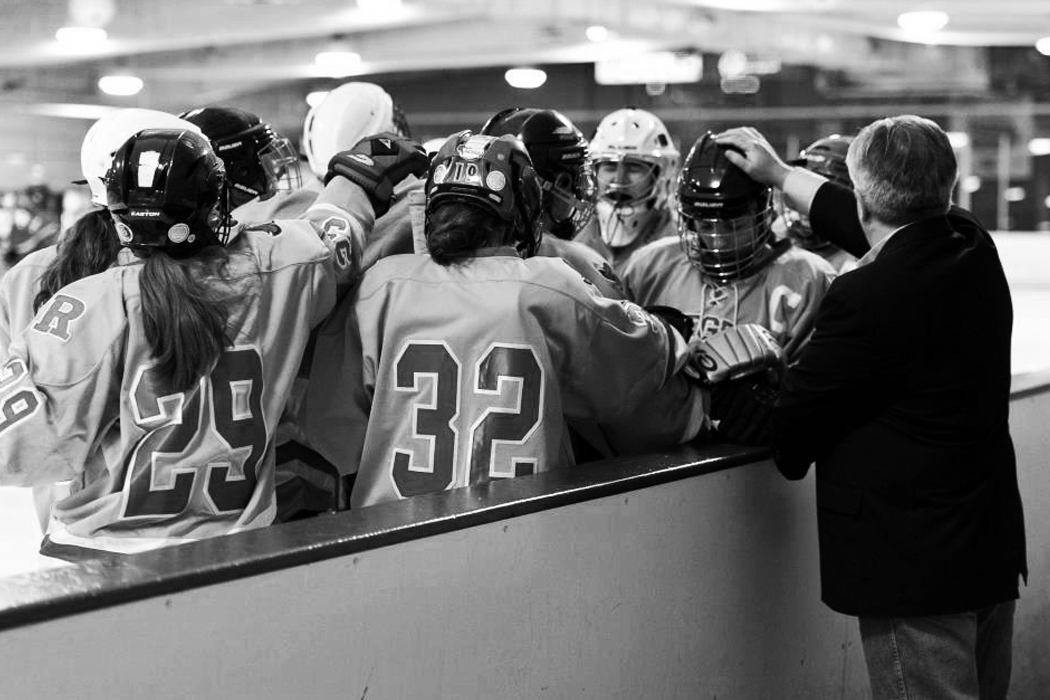
In lieu of the USA’s frustrating Olympic ice-hockey performances, once the disappointment set in, it was still impossible to overlook how very little attention the US Women’s team received. Both the men’s and women’s teams lost by one goal in extremely close and agonizing games (one a semi-final and one a final, respectively). These similar losses aside, the women’s team still placed Silver, while the men’s lost their chance at Gold, and eventually any chance of placing altogether.
What the Olympics do for the popularity of hockey as a sport is an extremely frustrating blessing. From the perspective of a previous player and avid fan of the sport, it’s rewarding to see it gain popularity, but the fact that only every four years women ice-hockey players are even acknowledged by mass media, leaves a bad taste in my mouth. And even more aggravating, is that the discussion surrounding women’s teams often places those women under more scrutiny than their male counterparts.
Perhaps the most interesting and controversial divider between the men’s and women’s teams, has nothing to do with their anatomies. Instead, what Olympic press neglects to highlight is that despite USA Hockey, the amateur hockey association of the United States, organizing both teams, comprises one of all professionals. The women’s roster is built from the best women’s college players across the nation, while the men’s team consists of paid professional athletes from the National Hockey League. Of course this wasn’t always the model for the men’s team (it wasn’t until 1988 that NHL players were recruited for the Olympics). While there is a technical difference in levels between the men and women, the reason the women are selected from a pool of collegiate athletes is simply because a national league does not exist for women, even if their skills are just as practiced, if not better than comparable men.
So why isn’t there a national women’s hockey league? Lack of support and interest. Instead, women play in NCAA leagues, if their colleges are even at that level. Even then, most colleges outside of hockey-centric geographical regions have teams in smaller, lower division leagues, that are often more developmental, simply because the popularity isn’t there. And often, at many universities, the men’s teams are much larger, more funded, and more accessible.
Division and league aside, women players have to train just as hard, if not harder, to prove themselves on the ice, without the support and sponsors that their NHL equivalents have access to. An athlete at the Olympic level of ice-hockey is one on a plain all their own. But patriarchy fears women who can out-perform men in the same settings. This isn’t to say that all women are better players than men, or vice versa; it simply means that they had to acquire the same skills to get on the Olympic plain. Instead of embracing the competitive nature of sport, most media have cultivated an approach to portraying women hockey players, and often female athletes in general, as lesser, weaker competitors.
This first becomes obvious when those same men who are glorified amongst NHL fans all 82-game season long, still manage to hold the reigns on the spotlight during Olympic coverage. And while it’s awesome to see some women hockey players highlighted in print at all, or even see Julie Chu in BP commercials, none of these women are given nearly as much attention, or credit, as their Sydney Crosby and Patrick Kane counterparts, and that’s flat-out unacceptable and ultimately, unforgivable.
When you Google search the USA Women’s Hockey team, one of the first articles that pops up is an opinion piece from The LA Times, which reported on the women’s Gold-medal game. The article highlighted the fact that the USA team broke down in tears after their loss against USA long-time hockey rivals, Canada. The whole article rambled about women athletes sobbing after battling for Gold and losing it. The article even had enough gall to absolve the women of being “rude” at the medaling ceremony, as if they needed permission to cry. What’s backwards, is that this sentiment is shared amongst several other media outlets, insulting the work those women put into their training, and their incredible athletic achievement as a Silver-medal team (that again, only lost by one goal!). Remarks were even made about their appearance after the game, as disheveled women who were much less put together after their competition than other women athletes of the games, specifically the women snowboarders.
Anyone who has played a hockey game knows players are not coming out of it looking pretty, win or lose, nor should that even need to be discussed. Do the men come out of their games with their hair perfectly quaffed and face free of sweat? No, you’re lucky if their teeth are intact.
After the women’s appearance at the medal ceremony, they received a lot of backlash for crying after their loss and on the platforms, some critics argue that their behavior was unsportsmanlike, as there’s “no crying in hockey.” Obviously those critics have never played hockey or watched an NHL game that’s full of cry-babies (I’m looking at you, Crosby). Because if those critics understood either of those dynamics, they would have been able to recognize that those tears were raw emotion, after months of practice on a journey for Gold that was shattered, and comparable to the effort of the boys.
Yet when the men begin to whine, like after the Russian men’s team lost to the US in an inspiring overtime shoot-out, Russian player and NHL favorite, Alexander Ovechkin complained on his Twitter that the loss was due to US goalie, Quick, cheating. The same criticisms the women faced for their tears were not allotted for him, nor did Ovechkin’s enormous reputation suffer.
In stark contrast to the how the females have been covered, the USA men’s team were remarkably praised. Leading up to the final games, players were glorified for their performances, specifically T.J. Oshie, for being an “American Hero,” after his shoot-out performance against Russia. Although, Oshie rejected the title, in all its absurdity, the fact remains that the media dubbed him a hero at all. It wasn’t until after they disappointed everyone in their semi-final round and lost to Canada, rubbing salt in fan’s still-fresh wounds from the Vancouver games, that the men heard even the tiniest criticism. Even more disappointing was the team’s performance against Finland for the chance at bronze, with the score 5-0, they seemed to have played without any notion of caring. And despite the team’s lackluster performance, complete lack of placing, and seemingly lack of interest, headlines surrounding the men hardly highlighted any of them crying, and were far more forgiving of their sloppy play-calling and weaknesses as a team. Instead, most coverage looked towards the players returning to their teams and the remaining NHL season. Meanwhile, the women’s team battled their way to the Gold-Medal round, without nearly as much media attention.
Gender aside and at the expense of this turning into a feminist rant, even without Gold medals, it’s inspiring to see hockey gaining more traction in the past two weeks globally, and that women are getting some coverage, even if it is vastly malnourished. According to Newsday, Hockey was the most mentioned sport on Twitter concerning this year’s games, which is pretty awesome (granted, there isn’t much going on in the sport’s world right now to compete with). But despite those Twitter numbers, there is something to be said about how desperately the conversation needs to change about women hockey players, and all female athletes for that matter. Everything from the diction used to discuss these women, to the amount of press they get, the entire ecosystem around female athletic coverage as it is, needs some heavy revamping; especially when there are articles surfacing like USA Today Sports suggesting that if the USA Women’s team lost the Gold, they would render women’s hockey irrelevant. Ice hockey is already one of the fastest, most high pressure sports out there, and it’s completely asinine to suggest that women have to prove their relevancy, when the men playing the same game don’t face that responsibility. There are plenty of women’s teams still skating and practicing across the U.S. despite the loss, the media just hasn’t reported on them.
Last time I checked, media doesn’t dictate the status of a sport, nor should it be the determining factor of its existence. Hockey was around before the middle ages and it’s time women start getting some of the attention the guys have been hogging.