The 2013 Sondheim finalist exhibition is worth checking out before it ends August 11th. But, if you missed it, here are Joyce Yu-Jean Lee’s impressions.

Steinhilber, All Photographs by Joyce Y. Lee
It’s summertime again, when Baltimore is abuzz with art, in large part due to the Janet and Walter Sondheim Prize. This year, the six finalists are four photographers: Gabriela Bulisova, Nate Larson, Louie Palu, and Larry W. Cook; and two sculptors: Caitlin Cunningham and Dan Steinhilber. For loyal Sondheim show attendees, the 2013 incarnation might feel somewhat small and crowded in the winding narrow galleries at The Walters Art Museum. The photography is better suited for the scale of these galleries, but the sculpture could have used more breathing room. The exhibition is separated into six small solo shows. This year’s jurors were Caroline Busta, a New York based art critic and associate editor of Artforum magazine; Jenny Schlenzka, Associate Curator at New York’s MoMA PS1; and Beverly Semmes, a mixed media artist known for her large-scale oversized wall-mounted dresses.
Bulisova
Gabriela Bulisova opens the finalist show with an exhibit entitled Time Zone, a narrative about a woman’s transition from incarceration for double homicide back into society. Nate Larsen’s Escape Route is a complex photo essay following the route of fugitive John Wilkes Booth, the famous stage actor who assassinated President Abraham Lincoln. Louie Palu’s Mira Mexico (“Look Mexico”) includes photographed portraits of people affected by the Mexican drug war. Larry W. Cook examines contemporary black male stereotypes through appropriated images and video from popular culture. With The Artist Is the Man Next Door, Caitlin Cunningham makes a wry protest against sexism in art. Dan Steinhilber transforms museum objects into an aural montage with his installation, Marlin Underground. Larson and Steinhilber’s poetic perspectives are more inquisitive and playful than the provocative Bulivosa, Palu, and Cook. Cunningham seems to be the rebel in the group. She uses a page ripped from the novel that inspires the title of her show to stand in as her artist bio. Each finalist’s unique approach merits a closer look.
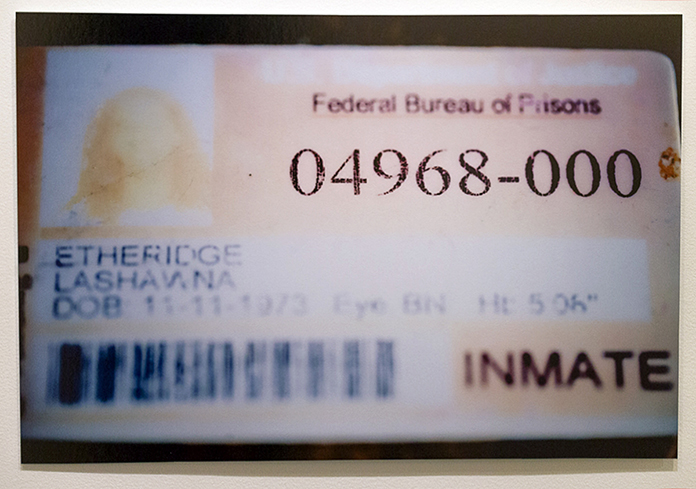
At the awards ceremony, Baltimore Mayor Stephanie Rawlings Blake announced the 2013 Sondheim Prize winner as Gabriela Bulisova, to which Bulisova humbly remarked she did not prepare an acceptance speech. In Time Zone, Bulisova makes a multi-faceted portrait of Lashonia Etheridge-Bey using photography and video. Bulisova favors reflections in windows, dark silhouettes, and partial and obstructed views. Her photographs provide glimpses into the quiet everyday moments of Etheridge-Bey’s life after imprisonment: her old faded former Federal Bureau of Prisons identification card; a snapshot photo with a soiled tissue wadded over a mysterious face; Etheridge-Bey lounging in a patch of sunlight on her bed.

Bulisova
Bulisova establishes an occluded and indirect gaze that successfully embodies the tension between the out-of-sight, out-of-mind lifestyles of incarcerated citizens and life outside. In her documentary video, she intersperses a slide show of these same stills among interviews with Etheridge-Bey, her friends and family. This photo slideshow seems redundant and unnecessary. Bulisova has talent for storytelling through still photography; so she could probably tell an exacting story with photographs alone.
Nate Larson’s Escape Routes is, in his words, a palimpsest. It is about “mythologies that we create for ourselves about contemporary life in the United States.” The fugitive narrative of John Wilkes Booth serves as the physical map for Larson’s photo series, and the memory path on which he builds images of American life. At the center of his mythology map is a grave-like photograph showing the grassy ground where Booth fell to his death, killed by Union soldiers. The photograph is placed on the floor and roped off so that viewers must look down on this effigy.

Larson
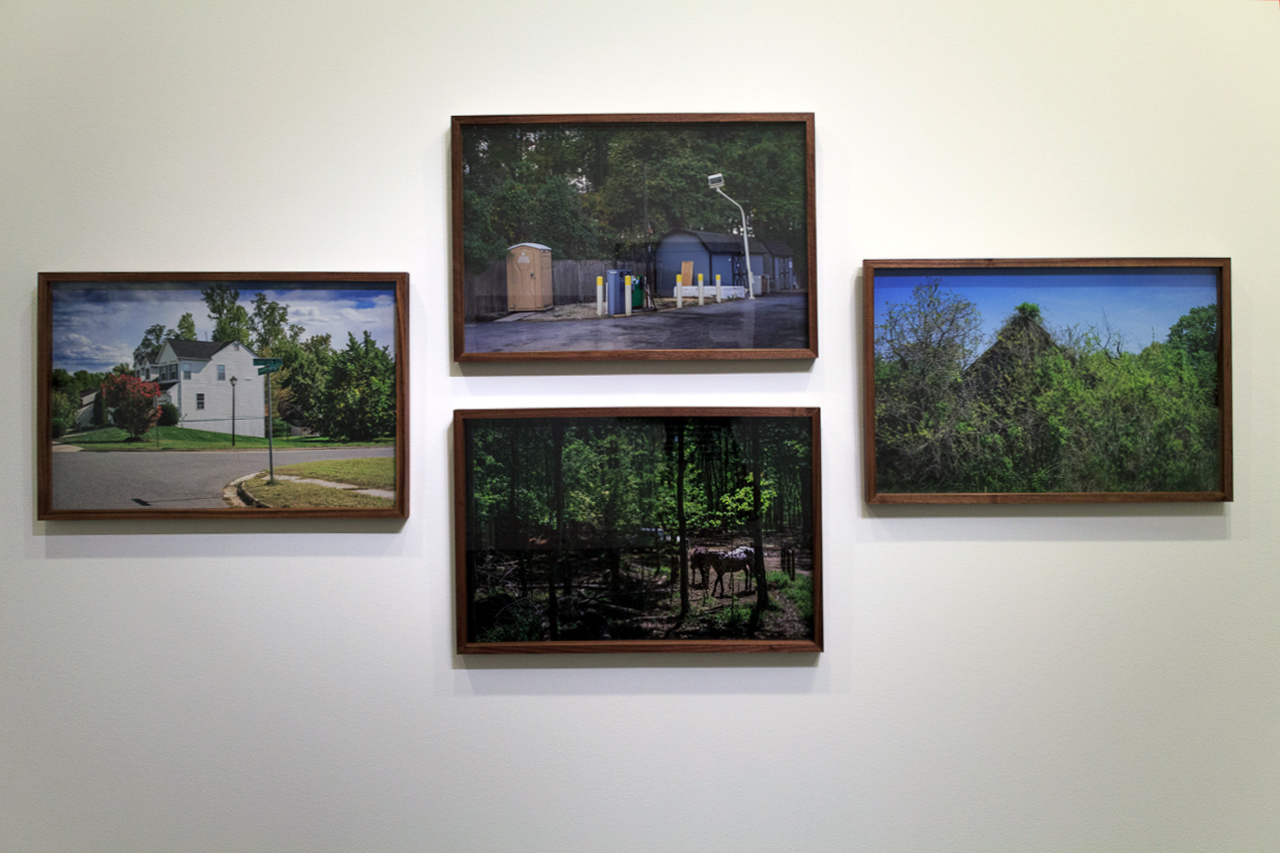
To me, the mythologies we create today are more engaging than rumination on the history of Booth’s flight. On the wall, Larson arranges framed photographs in diamond clusters of four, each quadrant forming loose relationships with other photos in the grouping. Two images of a residential subdivision and a BP gas pump are paired with rural pictures of horses in a wooded clearing and an overgrown farmhouse. My favorite is the grouping that shows a photo of blue sky, a second photo of green grass contrasted with a third photo of a hand painted “Eggs for Sale” sign, and a fourth photo of an AT&T factory. I like this quartet because there is an implied horizon line between the photographs of the sky and ground. Likewise, Larson delineates an invisible line historically between farming and the technology of modern times. These four photos tie together heaven and earth with past and present. But what exactly, or more specifically, is Larson revealing about these particular locations?

Larson
Larson
Louie Palu presents flawless black-and-white portraits of Mexican victims in his exhibition, Mira Mexico. Palu’s potent high-contrast war photojournalism proves the perfect medium for the grim casualties of the drug trade. Most mesmerizing are Execution by the River, showing the back of a male corpse with his face planted downward and his hands tied behind his back, and Self Beating, a woman with shorn hair identified as mentally ill, with a conspicuous black eye, donning a shawl..

Palu
Palu’s photographs stand tall and stoic without need for further embellishment. However, Palu also self-publishes a newspaper-style folio with violent versus non-violent pictures on opposing sides of the pages. He challenges the public to proactively curate the familiar barrage of news imagery. Viewers are invited to take a free newspaper from a wire stand, select an image from an index of photos reproduced from the exhibit, then affix that image to a magnet board. The magnet board displays examples and also includes color prints documenting similar projects in public spaces. Directly facing the original photographs, this exercise seems illustrative and self-referential. The newspaper would benefit from being placed in a different context than the gallery. If Palu’s off-site situations were demonstrated, say in a video, perhaps his vision of audience-mediated media might be more engaging?

Palu
Cook
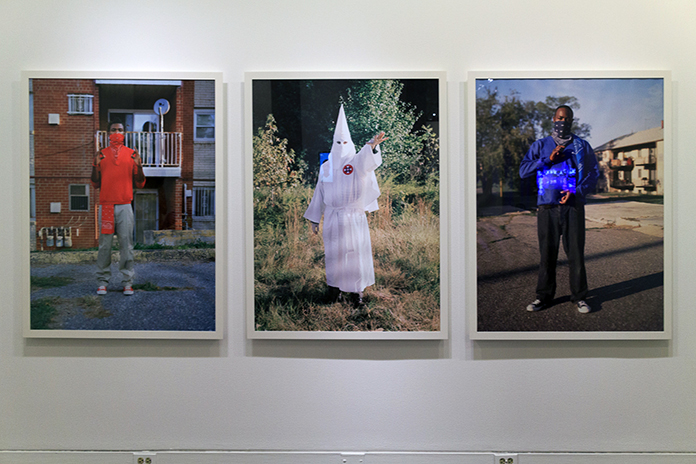
Larry W. Cook packs in a flamboyant punch. He contrasts historical film footage of Martin Luther King Jr. eternally paused between words of a speech with another work that appropriates a rap video showing black rappers spinning donuts in a high-end sports car. The car doors flung open like a futuristic mechanical insect, the audio of the appropriated music video is replaced with King’s speech slowed down to a frightening ominous drone. Nearby are still color portraits of black gang members and a figure wearing a white Ku Klux Klan hood.
Cook renders additional portraits on vertically oriented video screens, a nod to contemporary video artist, Bill Viola. Viola created head-to-shoulder moving portraits in works like Anima (2000) and Dolorosa (2000). Cook’s video portrait of Deandre, Aujena, Douglas, and Henry, depicts individual figures in a complex series of face-offs. The viewer can stand between these face-offs, or repeatedly turn from side to side to try to awkwardly watch the figures staring at each other. The work could be pushed further to solicit more of this interpersonal tension. Perhaps Cook would make his point better if the figures were to reveal sooner their eventual surprise smiles?

Cook
Cook holds promise as a young artist, however, the selected work is a bit all over the place and lacks the focus of the other finalists. Additionally, his artist statement postures too much without saying anything substantive.
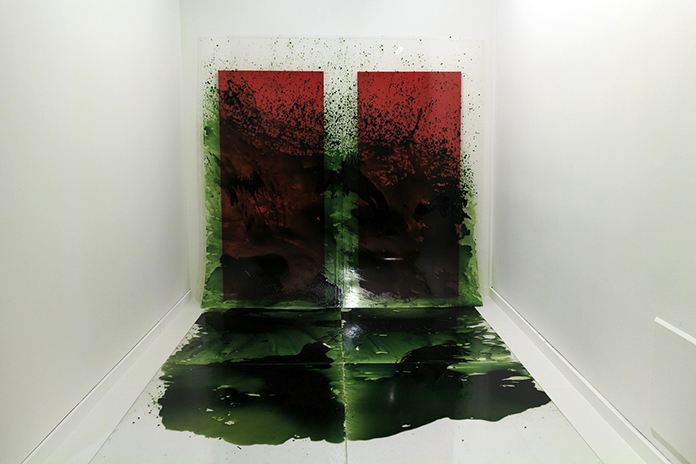
Caitlin Cunningham may alienate the general museum attendee with her concept-heavy staging, but art insiders may get a good chuckle from her smart juxtapositions. One of two women Sondheim finalists, she presents declarative works about the colonial western world in The Artist Is the Man Next Door. She uses titles lifted directly from collaged texts like Men, Rebellion, Conquest; and quotations from found postcards such as: They Are All Like That but Unfortunately Don’t Go around Barebreasted. Cunningham is not shy about her feminist point of view. I think she teeters on the edge of being perfectly appropriate and too heavy-handed. But she proves she can play a traditionally masculine game with the same bravado of celebrated male artists.
Cunningham
This is highlighted best in Jack/son Torrance, floor-to-wall splashes of dark green liquid chlorophyll on brick-red wooden panels and plexiglass. Cunningham mashes up the name of American Abstract Expressionist drip painter, Jackson Pollock with that of Jack Torrance from Stanley Kubrick’s film, The Shining. In order to decipher her visual riddle, I googled “Jack Torrance.” I stumbled upon the film still of the elevator hall from the film and realized it’s an exact compositional match. The double panels in Jack/son Torrance echo the two elevator doors from The Shining, which were flooded by a torrent of blood in the protagonist’s nightmare. Cunningham’s gestural painting simultaneously pays homage, yet also criticizes the renegade legacy of Pollock and Torrance. Played by Jack Nicholson, Torrance is rated by The American Film Institute as the 25th greatest film villain of all time. Cunningham questions whether the key figures of male-dominated cultural history should now be regarded as heroes or villains, famous or infamous.

Cunningham
Without Internet research, Cunningham’s content is probably too cryptic for the average museum audience. I wonder: How can Cunningham affirm her focus on concept while clearly communicating her message?
Dan Steinhilber’s Marlin Underground ends the 2013 Sondheim finalist exhibition on a light-hearted note. Steinhilber mined found objects from the portion of the Walters Museum that once used to be the Walters’ family home. He leaves the gallery wall colors mostly as they were in the previous exhibition—sage green, warm grey, and patterned zig zag. Upon first view, one might assume the ramshackle presentation is some kind of eccentric archived collection. We see blue marlin mounts, file cabinets, and household appliances. We hear clangs, whirrs, dings, and beeps layer upon each other in a noise symphony of banal sounds.
Recorded sound is the star of Steinhilber’s exhibition. He reveals the crux of his creative process in his artist statement as the “unfinished condition, both domestic and institutional.” Black sound cables tumble off the front edge of an altar-like control table much like a DJ’s. Unique digital noise is triggered by walking up to each object, amassing into a techy composition that borders on performance. I do not associate Steinhilber’s installation with what he calls “the memory mess of our mind making music.” Rather, it comes off to me as something altogether different from conventional notions of music making.

Steinhilber
I do not admire the Sondheim jurors’ job of selecting prize-winners. Gabriela Bulisova is celebrated this year for her humanistic photographs and video that sympathetically represent a civic concern. But all of the finalists are noteworthy. As a whole, the exhibition reveals the diverse talent of local artists from the Baltimore and Washington D.C. region, as well as the wide range of interesting topics engaging artists now.
——
Joyce Yu-Jean Lee is a visual artist who works primarily in video installation, drawing, and photography. She teaches part-time at the Maryland Institute College of Art (MICA) and can be found cruising Charm City on her trusty bicycle. Art Criticism in What Weekly (whatweekly.com/artcrit) is made possible with the generous support of the William G. Baker, Jr. Memorial Fund, creator of the Baker Artist Awards, www.BakerArtistAwards.org. Marcus Civin edits these art criticism articles for What Weekly. He also teaches at MICA. Contact marcus@whatweekly.com.