by Janet Stidman Eveleth
One of my fondest holiday childhood memories is my family’s annual trip to the firehouse to see the enchanting train garden. I gazed in wonder at model trains chugging down the tracks winding their way through quaint little towns decked out in festive, holiday spirit. This unique Baltimore tradition of firehouse train gardens continues to delight children and families every holiday season at the Fire Museum of Maryland, Arbutus Volunteer Fire Department, and Wise Avenue Volunteer Fire Department in Baltimore County.
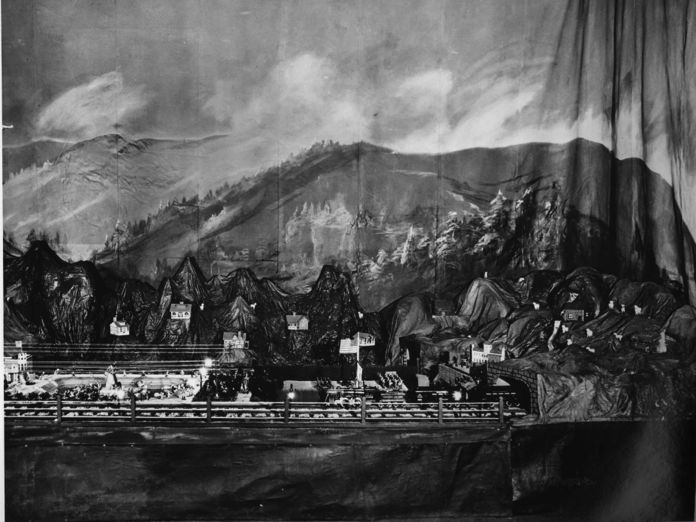
Christmas Train Gardens in firehouses began in Baltimore, dating back to the 1800s. Moravians immigrated and settled in Baltimore and brought the tradition with them, to the delight of Baltimoreans. Moravian holiday gardens carried a religious context, showing a Nativity scene with a little fence around it, displayed under a Christmas tree during the holiday season in remembrance of the first Christmas. It is believed these gardens had roots in Rome where refugees chiseled scenes connected to the birth of Christ in rocks and walls. In the mid-1800s, some people started putting in small wooden trains around the outside of Nativity fence that the children could push around.

While Baltimoreans loved the holiday train gardens, they sought to expand them beyond religious scenes. By the late 1800s, and with the invention of the electric train set, Baltimore developed the concept of an electric train circling a Christmas garden. But it was Baltimore’s firefighters who envisioned Christmas Train Gardens as a way to create good will and holiday spirit in the community. Under the firefighters’ leadership, train gardens took on a life of their own, conjuring holiday spirit in the community.
Capt. Eugene Daly, Engine Co. 28, Gilford Avenue was the first to set up a Christmas Train Garden in 1917, shortly after WWI. Once the steam-powered fire engines and horses were replaced with motorized apparatus, the Garden grew substantially. The original train gardens were handmade of wood, paper, and cardboard and included churches, waterfalls, houses, stores, flowers, and other symbols representing a town.
The idea caught on and other fire houses built gardens of their own until 1939 when the fire department ended the tradition. The administration said fire fighters were spending too much time building them and the crowds of people were impeding their operations.
Nearly 20 years later, two Gardens were established, one at Engine 4, Cold Spring Lane, and at Engine 45, Cross Country Blvd. As the gardens grew in popularity, they also grew in size and content. Some of today’s gardens even contain fires, water pumps, traffic lights and cars. Some firehouse gardens have even expanded to the point where the fire engines must be moved outside.
The Fire Museum of Maryland introduced a portable floor model in 1978, designed by volunteers featuring 1940’s style, O27 trains and O-gauge tracks. Eventually it was converted to a permanent platform in the Discovery Room.
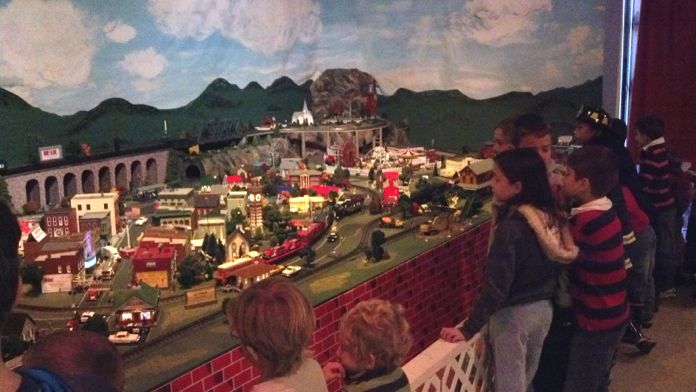
This year, the Fire Museum in Lutherville, MD, unveiled a completely re-designed Holiday Train Garden showcasing a 1950s “O” Scale Train display. The Museum’s new Christmas garden captures the essence of Baltimore’s unique tradition, depicting a replica of the Baltimore City and its surrounding counties.
Trains chug through farms, small towns and city scenes, passing by such icons as the Maryland Zoo, the Bromo Seltzer Tower, Gwynn Oak Amusement Park, the Lutherville Train Station, the Arbutus Volunteer Fire Department, and the Thomas Viaduct. The Good Year Blimp hovers above.
The Fire Museum of Maryland’s newly constructed 10 by 26 foot Train Garden is open Saturdays in December, and the week after Christmas, December 27th – 29th. The Train Garden and the Museum Shop are open exclusively Tuesday, Dec. 18th – Friday, Dec. 21st, 6:30 – 8:30 pm, for a special viewing at a reduced cost. The rest of the Museum will be closed during those evening visits.
Also on exhibit are 40 antique fire engines and a reconstructed 1871 fire house. Children (2 – 18) $5, Adults $12, Seniors and Firefighters $10. The Fire Museum is located at 1301 York Rd., Lutherville, one block north of the Beltway, exit 26B, ample free parking, 410-321-7500, www.firemuseummd.org