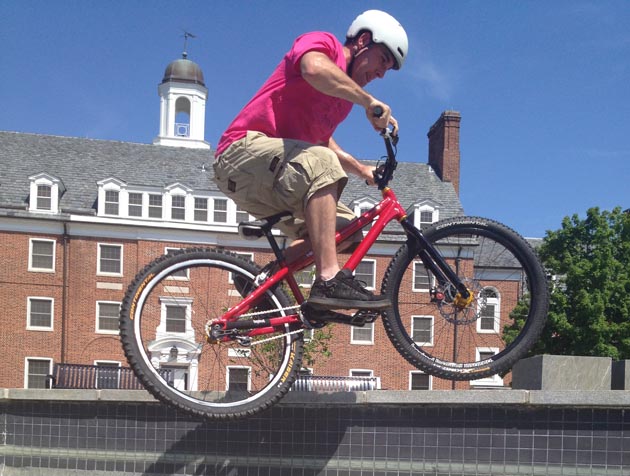
Grant Whipple pedaled down the bike path. He was thinking, watching, passing through space and time. A small brown gray patch emerged on the path in front of him. He felt the wind against his bearded face, the muscles in his hand tighten around the brake, his balance adjust; he saw the trees, the ground, the sky with increased clarity; time itself both extended and contracted as the moment became protracted, oblong and crushed.
There has been some interesting scientific research about what happens in such moments, about how time seems slower when we recollect tense moments because the adrenaline heightens our memory so that when we recall the event so many things that are normally lost or escape our recollection come flooding back and the memory itself takes longer.
But Whipple, a painter finishing grad school in Michigan, investigated this, and other more traumatic “Protracted Moments,” in a series of 6×8 paintings now on display at the Windup Space. He engages extreme—if mundane– moments visually and philosophically and discovers in the world of motion moments of preternatural stillness: his phenomenological paintings attempt to recreate this stoppage and expanding of time that occurs in the moment of crisis or catastrophe: car wrecks, floods, the moment the glass breaks, running over a squirrel on a bike.
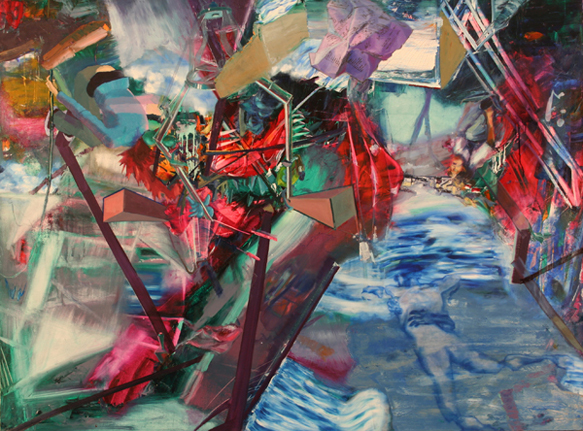
This choice of subject matter proved to be the perfect vehicle to engage with the history of painting and to break open many of its dichotomies.
I met Whipple at the Windup Space the other day to talk about his work. A young guy with kind of poofy hair and a beard, he moved to Baltimore from Michigan, where he finished grad school, and the paintings on display, last August.
“Painting has traditionally been conceived of a as a static medium: between the Renaissance and Cubism, the model of painting was the mis-en-scene of the window out onto the world. Cubism, Futurism, and other early twentieth century avant gardes challenged that perspective. But once again, in the age of installations and video art, painting is perceived as that most static of media. It seems like you play on that and make these catastrophic moments still– you capture them in painting– but in doing so you make the paintings move, or something like that.”
I was running some of the ideas I’d gotten from his paintings past him. He took issue with my art history, insisting, “It’s more vacillating between those, from Renaissance to Baroque in taking an otherwise still moment and shattering it.”
That was the process Whipple himself had recently gone through. His earlier works had been studiously constructed still-lifes which he had attempted to make “as still as possible. Objects like a contact kit my dad had from the sixties that actually had this suction cup to take the hard lenses off with… Or a screwdriver or something.” In these newer works, he said, he is “taking those paintings and shaking them up in a snow globe or a cracked mirror. They grapple with the fluidity of the moment and the abundance of information but still try to sort it out.”
This is the second major tension that Whipple’s chosen subjects– moments of crisis– lend to his work; they are born from the “unstance between abstract and representation.”
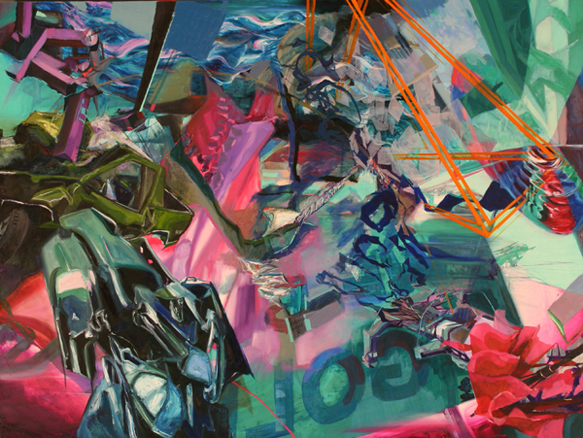
Before we got into this, we ordered a second beer from Holly, whose tattooed fingers were busy quilting behind the otherwise empty bar, and then drifted back over to the paintings. “Because they are so gestural most people assume they are entirely abstract paintings. But there is an extension of time you get with finding that representation anti- or dissolving figurative painting. But they are in dialogue with the grand figurative tradition.”
The colors and abstractions resemble the work of the German artist Gerhard Richter. Simultaneously with his abstract paintings, Richter created photorealist paintings that also froze action– but in the wavy way of a paused vcr. Whipple seems to seize on Richter’s dual impulses and bring them together within the same work. Instead of creating two kinds of works simultaneously– to avoid the ideology of style– Whipple takes both of these impulses, puts them into the same painting, and uses that to push the viewer back out into the fragility of his or her own life and the wonders– and the formal structures– of time. IN doing this, he creates, and embraces, style, and it is all his own.
It actually takes a while to see some of the figures in the paintings, but when you do, they’re unavoidably representational. They emerge in the space between Michelangelo, cartoons, and social realist figures. They are caught in action. In one painting, amidst rich magentas and thalo blues, there is a wavy figure submerged, swimming perhaps, beneath a swath of water. But I looked at the painting several times before I noticed the other figure, trapped in motion, suspended in becoming, seeming to do a flip off of some sort of tree or wall that is itself made vertiginous by motion. The figure is both solid and fluid—in other words, in danger.
In another image, the orange bike is obvious. But the wine glass, stained and shattering, and then the hand hovering above the inverted scene spectrally, take time to discern against an explosive orange. And yet, once I noticed them, they stuck in my mind, like icons of things I’d lost.
The best paintings are those that require time and return the investment in interest… and yet, lest I make Whipple’s paintings sound too serious, these are fun, visually arresting paintings. The colors are rich and vibrant and the gestures grand. I just talked with Whipple yesterday and I already look forward to seeing the paintings again. I will be returning to the opening at the Windup this Saturday, March 12, at 6:00 to look at them again, and several more times, I am sure, before they come down at the end of March. I will go as much for the joy as for the intellectual stimulation.