When I was growing up in Schenectady, New York, my mother would ask me to attend her symphony orchestra concerts. She played the flute. With the request, she would add, mockingly, “You need to get yourself some culcha.” I had no idea who or what she was mocking, but growing up in the 60s and 70s in my nearly all white suburb of Niskayuna” (that’s right, Schenectady has suburbs) there was a sense that culture was kind of obsolete—nice, but unnecessary.

Our fathers fought the Second World War, and returned with a plan: America, the only industrial power left standing, would focus on building the future—without looking back. Culture was for Europeans or those who lived in Brazil or Mali. Our society would leap into the future, and life would improve in tangible ways. We would produce practical things—technologies that would both lengthen and defend life. The meaning of anything else we did: religion, ritual, sports, social organizations or the arts, however engaging, was inherently less important. The huge General Electric logo atop the huge plant downtown, hovered like an oracle at one end of Erie Boulevard and seemed to align everything and everyone behind “the plan”: a people free to pursue truth, will discover the secrets of the universe and supply us with everything we need to be happy. G.E. Global Research (centered in Munich, Bangalore, Shanghai and—you guessed it: Niskayuna), and the nearby Knoll’s Atomic Power Lab were the real things in our world—the things that mattered. General Electric Broadcasting, WRGB, was right up the street and the home of the first commercial television broadcasts. TV critic David Bianculli credits it with establishing the model of no dialect for news anchors; my town was like a cultural disinfectant. My Dad was part of the team developing silicone. I had more Silly Putty than any kid alive. I could lift the imagery and words from an entire newspaper page, then squish the “flesh tone” mass back together, and see it disappear, forever.
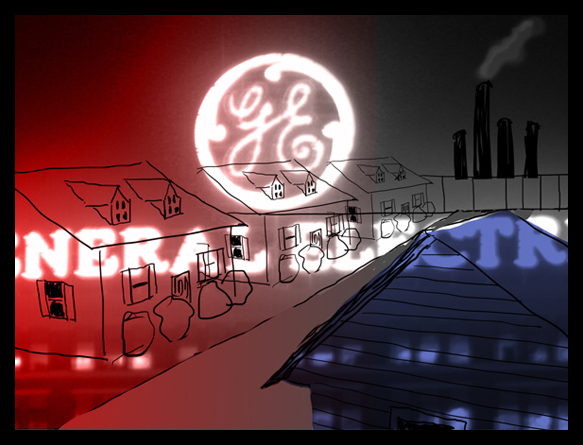
Following my liberated mother away from the Church at the age of eight, I learned to believe that the world of possibilities emerged when the social fabric of our grandparents’ time was cut up and used to patch our jeans. I had a class in junior high called World Culture, but other than that I don’t remember the word culture crossing anyone’s lips more than a few times when I was growing up. Art school expanded my universe—I became a bit more aware of other cultures. They seemed rich, impressive, often exotic, but remote.
The ironic fact that culture doesn’t really matter in our culture is unfortunate because for us, as for all people, culture forms the social norms that guide us most of the time. It’s how we humans work. It brackets our possibilities. You can see our real culture reflected in what we do, but you won’t often hear it mentioned in what we say. “Never underestimate the power of denial.” (Ricky Fitts – American Beauty, 1999.)
-Lee Boot