Benjamin Andrew advocates for a new and creative criticism!
All images by Benjamin Andrew, 2013
BALTIMORE – An ongoing crisis in the world of art criticism has left many writers stunned, unappreciated, and in many cases, without a job. The malaise and wordy angst affecting the art industry in recent years has culminated in an unprecedented amount of criticism about the current state of art criticism. Some attribute this dire plight to advancements in technology and the art market, while others say the crisis has been growing for decades due to attention-deficit readers hungry for celebrity, spectacle, and crisis.
To wit: earlier this year Dave Hickey proclaimed that “THE ART WORLD IS STUPID” [sic]. The renowned author and critic was one of many who participated in a barrage of criticism printed in the Brooklyn Rail responding to questions posed by another critic, Irving Sandler, on the state of art criticism itself. Hickey’s blaring lampoon of his abandoned territory was echoed in the other responses to Sandler’s query, and represents the general sense of helplessness that many critics have attributed to their field.
The crisis in traditional criticism has in part been caused by a shift in public attention towards ‘art news’, an expansive genre that includes general interest newspapers and magazines, as well as blogs and aggregators. Ask who today’s most influential art writers are, and you will likely hear the names of the regular columnists for The New York Times and New York Magazine. The role of journalism has historically been to make accessible the sometimes-obtuse world of visual art to the general public, but recently the voice of journalism has become the central frame of reference for many artists and the general public. Its proliferation has been fueled by lean reportage on crowd-pleasing topics to compete with sports, cinema, fashion, and other largely apolitical news genres.
Traditional art critics, on the other hand, stand somewhere between art historians and armchair anthropologists: describing and evaluating works of art in a simplistic top-down model. Tying together descriptions of form with philosophical musings, traditional criticism often demands sustained attention and supplementary research – two things rarely found in contemporary media.
Art criticism is conventionally recognized by its magniloquent writing style, academic ties, and devastatingly accomplished authors. Criticism can also be recognized by its fond insistence on bibliographic footnotes, while journalism gets away with quoting via brief attributions or hyperlinks. These stylistic tropes and a general opaqueness to non-insiders have contributed to the perceived obsolescence of criticism. Historically, critics have influenced the trajectory of art’s progress by championing and expanding the dialogue of certain artistic styles (eg. Donald Judd’s writings about minimalism), but contemporary art seems to be too widely spread and multifarious for any writer to wrangle into any thematic direction.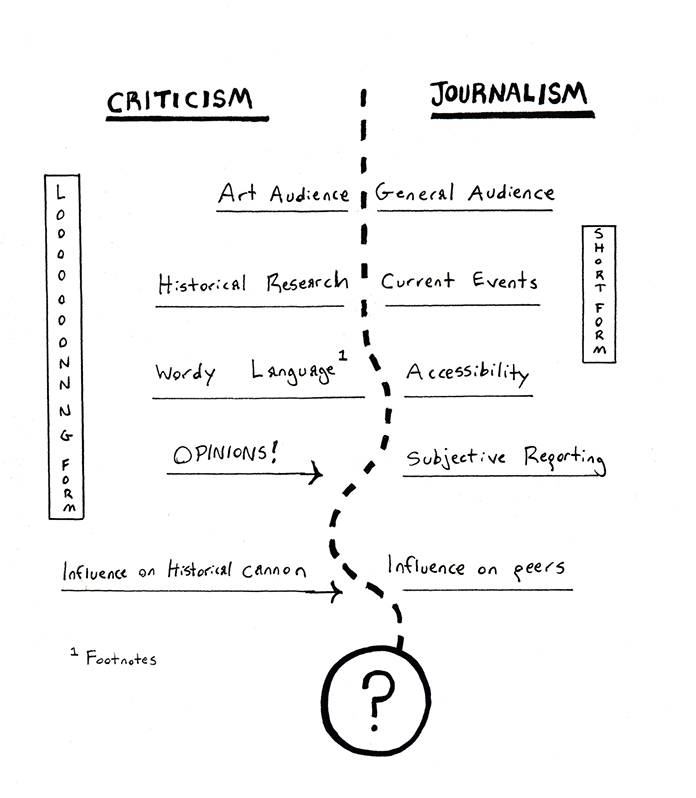
The art critic’s long-trusted technique of formal analysis seems about used up as well. If it is the journalist’s job to alluringly describe an exhibition or event, then perhaps the art critic’s time is best spent elsewhere, especially when nearly all journalistic writing is accompanied by eye-grabbing images and video. In the Brooklyn Rail, critic Barbara Rose wrote that criticism is “as relevant as cuneiform,” leading many to turn to journalism for responses to contemporary art.
While it is easy to label journalists as simple crowd-pleasers, a survey of art critics published a while back, in 2002, by the National Arts Journalism Program at Columbia University, found journalistic critics facing many of the same problems as traditional critics. The more than two hundred journalists surveyed by the NAJP point to the overarching dilemma: mass audiences just don’t care about art… at least reading about it in print. While the survey found 85% of major general interest newspapers and magazines in the US had at least one resident art reporter, visual art received substantially less paper space than other areas of art and culture. The study cites a previous report that found visual art to occupy only 6 percent of all arts and culture pages in newspapers, and two out of five art columnists doubted if their organizations would replace them if they left their jobs.
With art writing losing its print audience and its column inches, its no wonder that “almost two-thirds of [journalistic] critics prefer to write in a positive vein about art,” as the NAJP reports, and that “many deliberately eschew negative criticism, preferring to be proponents and champions of artists, especially local ones.” This effect is evident in developing art communities like Baltimore where many artists and writers know one another. This tendency has given way to what Miller dubs ‘infotainment’ – a dangerous strategy that risks turning art writing into a better-dressed Fox News.
With journalists already sacrificing their objectivity for readership and local proselytizing, many seem at risk of becoming critics themselves. This ambiguity is particularly exemplified by web sources, where reviews blur with event listings and personal anecdotes in high-speed bursts of information delivery. Are these two categories – art criticism and journalism – still relevant?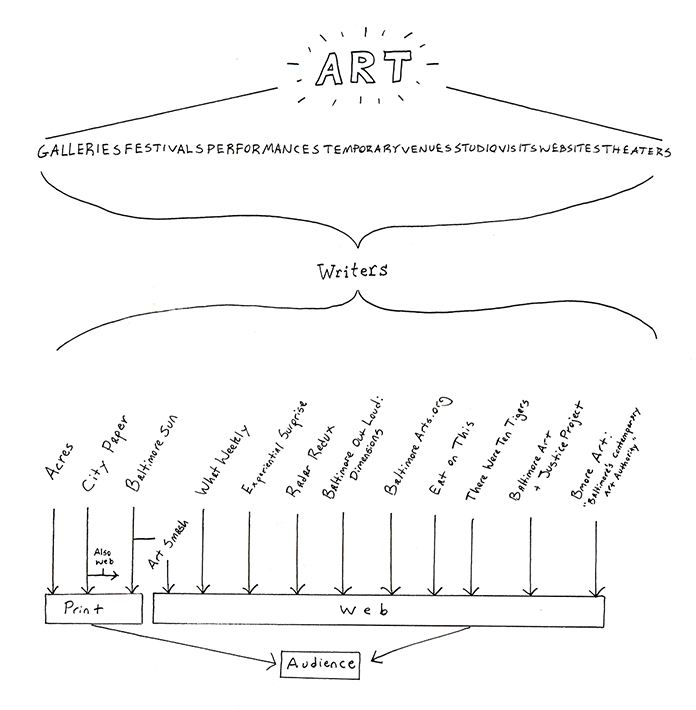
If nothing else, these historical categories can be used to judge the depth and importance of writing. Baltimore’s sphere of art writing consists overwhelmingly of journalism, with single page articles in City Paper and Bmore Art, for example, often functioning more like publicity for local exhibitions than discursive thought. But that doesn’t mean tediously academic criticism will assist Baltimore’s cultural dialogue either; progressive art writing should refuse these categories, take the best parts of each, and create writing that is interesting in its own right.
In an 1890 conversational essay, The Critic as Artist, Oscar Wilde wrote: “to the critic the work of art is simply a suggestion for a new work of his own.” While art writers still attempt to direct the goals of contemporary art and review an ever-increasing number of exhibitions, the decline of traditional critics should be seen as an opportunity for writers to produce interesting and creative criticism.
————–