Photos and words by Anissa Elmerraji
 Aaron Henkin
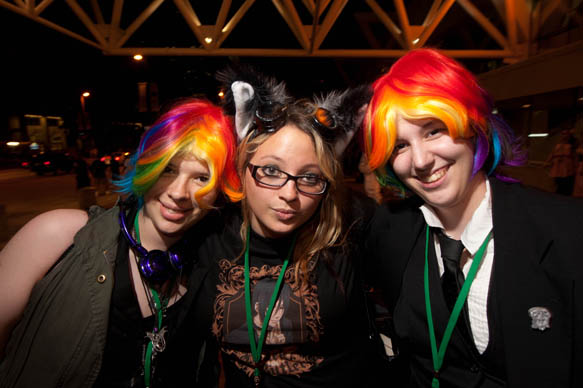
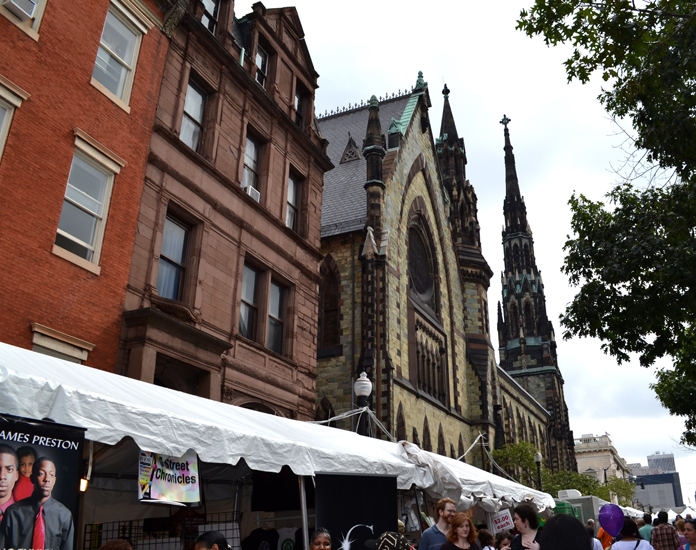
It’s difficult to say which is more potent. The brightly-colored balloons, the smell of freshly powdered funnel cake and overpriced veggie lo mein, unexpected bubbles, the deliciously disconcerting stimuli produced by people, music, and alcohol, or the novelty of hearing a celebrated author lecture on a sidewalk. What is certain is that there is something about festivals (well, it’s probably the alcohol), have tendency to create a sense of hey, let’s be friends, just because. At the Baltimore Book Fest, held in Mount Vernon last weekend, that phenomena was not only felt, but was accentuated by the fact that what was being celebrated—books, in paper form—have been met with pretty stiff competition as of late. The festival itself, and everyone present, gave weight to the idea that books are still important and are worth being celebrated.
 Baynard Woods
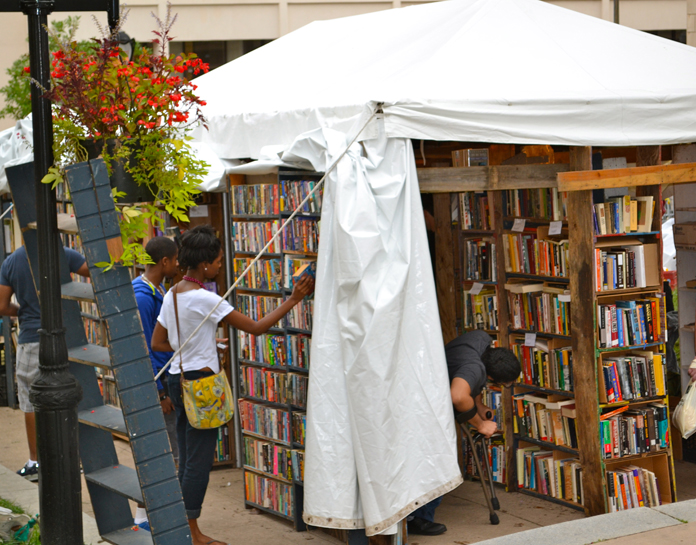
This year Baltimore Book Fest, now in its 16th year, had all the staples of book fests prior: dozens of bibliophilic institutions represented in little white tents, makeshift used book shops crowded with people scanning spines for a weathered gem, bands playing Beatles covers, and, of course, torrential rain. Among all this beautiful chaos is the point of the festival: authors, local and otherwise, who come to share their work. Here’s a look at some of the authors that made appearances this weekend.
 Gregg Wilhelm, Stephen Janis, and Kelvin Sewell
Despite the $4 billion spent on policing in Baltimore, Charm City’s not-so-charming reputation with crime is still a serious issue. On Saturday, co-authors Kelvin Sewell, a former homicide detective for the Baltimore City police and Stephen Janis, investigative reporter from WBFF FOX45, talked about the book that took them two years to complete, Why Do We Kill: The Pathology of Murder in Baltimore. “People need to know exactly what goes on in Baltimore,” said Sewell when asked why he and Janis tackled the project. The book is meant to be an eye-opener; a way to give the public a look at several horrific cases witnessed by Sewell, like that of 14-year-old Devon Richardson who shot a 67-year-old woman in the back of the head because his brother dared him to.
Janis stressed that the problem in Baltimore is not crime, but a lack of transparency. Deaths are being recorded as numbers, not as people. The discussion revealed the circular perpetuation of crime by way of seemingly uncontrollable environmental factors, like poverty, and drugs, and gangs that claim kids as early as middle school. Coupled with this are limitations placed on the police force by the strained economy. “You cannot work a homicide case on 8.2 hours a day,” said Sewell, who was often frustrated by cases put on hold because of a non-existent budget for overtime.
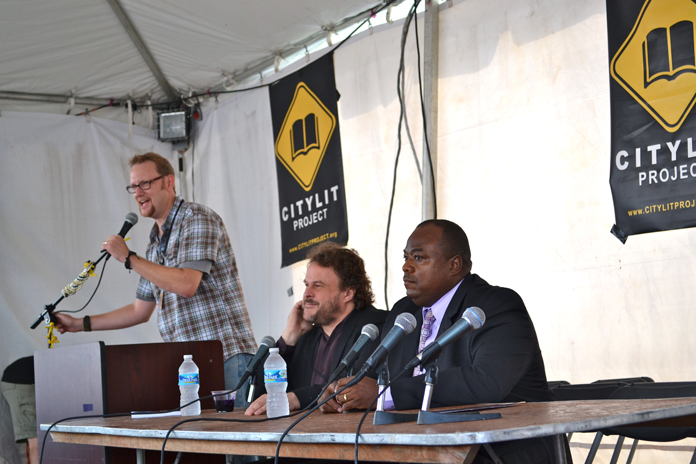
Less distressing than Baltimore homicides, but still increasing cause for concern, are the future of journalism and the plight of the aspiring writer, which were topics discussed during “Opinions . . . everybody’s got one: Writing about what you love, what you hate, and the everything else that makes up the majority of life.” Former City Paper Arts Editor, Bret McCabe moderated a discussion between six local bloggers slash freelancers slash new-media experts: Michael Corbin, (Urbanite, City Paper), Rahne Alexander (City Paper) Jerry Mak (Giant Robot, Flavor Pill), Brooke Hall (who you might remember from publications such as this one), Umar Farooq (Indypendent Reader), A.F. James MacArthur (investigativevoice.com).
If there was one take-away message from the discussion, it was that writing as a profession is hard. It’s really hard. But, not impossible. “Find your niche,” was the advice of Mak, “don’t whore yourself out” to just any type of writing in order to turn a profit. The panelists agreed that writing on what you’re passionate about is a crucial ingredient of good writing. Hall’s advice to aspiring writers: start a blog, and build your audience.
The panelists also discussed the changing face of media in an age where the instantaneous feedback from platforms like Facebook and Twitter are making digital news more appealing. The popularity of blogs, argued Corbin, is changing the format of journalism. Longer writing isn’t selling, so writers have to write short. And, snappy. And, to the point. The threat of digit media to its print counterpart was also discussed. Hall predicts that print magazines will soon become a luxury item, just like they were at their inception (and the circle goes round and round).
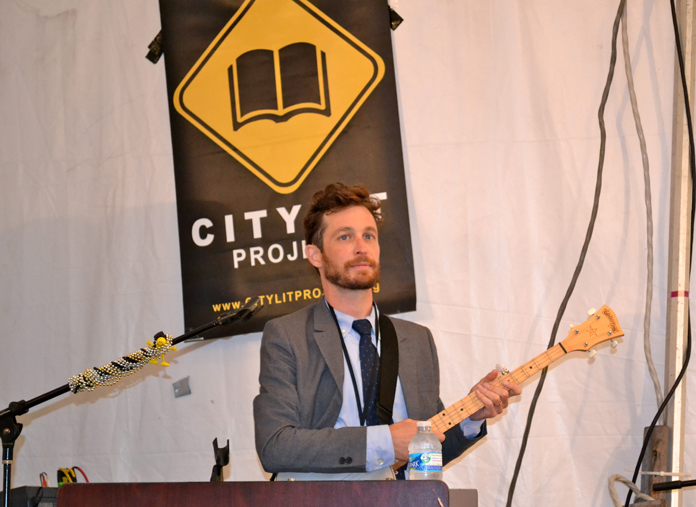
It wouldn’t really be accurate to call what went on in the CityLit tent on Saturday night a series of book readings. Yes, books were read, but “Not from these parts: Readings by Non-Hometown Boys,” hosted by Aaron Henkin, co-host of WYPR’s “The Signal,” was really equal parts live radio-show and folk concert. Spectators were lured in by Henkin’s resonant ringmaster-esque voice and the promise of free beer, but stayed to hear the infectious tunes of the dapperly-dressed Barnyard Sharks, a six-man band featuring the likes of Henkin on drums, Baynard Woods on bass violin, and Jason Reed (named best folk musician by City Paper).
South Carolinian Baynard Woods was the first non-hometown boy to read from his novel, Coffin Point: The Strange Cases of Ed McTeer, Witchdoctor Sheriff. But, again, Woods didn’t so much read from his book–a rollicking tale a low-country voodoo–as perform a passage of his novel with a delightfully animated southern twang, punctuated by interludes on his banjo.
Californian Mike Young read from We Are All Good If They Try Hard Enough, a book of poems dripping with absurd imagery and structured around hilarious non-sequiturs that, in a wonderful and bizarre sort of way, just made sense. During “Let’s Build the Last Song and Sneak Away While Everyone is Listening,”—a love poem—Young unveiled two iconic Baltimore lovers: a bag of potato chips and a can of Raid, and used the props as puppets during the reading. In, “For You to Finish While You’re Swimming,” an advice poem that Young wrote for a friend’s newborn son, he sums of life as an “evil pancake,” but then lists what can be beautiful about it. Like, “drinking coffee together with your favorite naked person at the time.”
The readings closed with Dominic Smith, originally from Sydney, Australia, who, after apologizing for his lack of a more pronounced Aussie accent, read a richly descriptive passage from his novel Bright and Distant Shores, a historical novel set in 1897.
The ongoing decline of print does not mean that literature will decay with it. Though the number of print outlets continues to shrink with no end in sight, there will always be writers with ideas to communicate.
There’s something about a book, a tangible thing that you can hold in your hand, that’s inherently satisfying. So, cheers to the Baltimore Book Fest for reminding us of that tradition, and let’s hope it continues for at least 16 years more because frankly, an e-book festival just wouldn’t be the same.
Photos and words by Anissa Elmerraji