Photography by Epic Media
Lexington Market hosts the best events in Baltimore City. It’s the only place where you can eat lunch alongside an elephant, bet on live crab races, and witness a horse mounted police officer chase down a car; Lexington Market is world famous and it couldn’t be more obvious why.
My faith in the Market’s ability to entertain was tested during the 10th Fashion Show and it was rewarded a thousand times over.
I arrived in the cold, cutting through the zombified throngs of people standing aimlessly on Eutaw Street. As soon as I entered the building the atmosphere shifted immediately. A thumping techno song rumbled through the brown linoleum and people swarmed around an eighty foot runway that had been erected in the heart of the Market’s main lobby. I zigzagged past gaggles of bystanders and pushed towards the second floor to get a better view of the layout. Below me were hundreds upon hundreds of people who had either shown up for the fashion show or were there by proximity; regardless, they were staying, and the threat of snow only packed more bodies into the already claustrophobic standing room sections.
I made my way to the roped off section of the VIP zone that separated the audience from the dressing rooms and was introduced to the presenter, Travis Winkey. He was a springy, slender man whose dark clothes were offset by his bright orange hair. With one arm across my shoulders, Travis navigated me into the dressing room where he waved his hands over an array of half-dressed men and women and said, “Write what you want!” Smiling, he turned and spoke with a group of models that were making last minute adjustments to their outfits and makeup.
Everything that happened next occurred at a speed I was barely able to comprehend. The way that the people in the room snapped to attention when Travis spoke reminded me of a military theater where he played the role of the commanding officer, instructing his troops before battle. With the clap of hands a circle formed around him, and the models turned their attention towards his voice – their conversations dying mid-sentence.
“Talk to the audience,” Travis commanded, “Let them know who you are. Once it’s your turn to go, I want you to trot ON and trot OFF. I want you to have a good time out there. But I need you to give them [the audience] a little bit so they want more.”
After the brief pep talk, a man walked into the center of the room and asked everyone in attendance to lower their heads in a moment of silence, wherein he mentioned Nelson Mandella, Martin Luther King, Usher, Beyonce, and Jay Z. As the prayer neared closure, he seamlessly transitioned into an impassioned appreciation, “Thank the lord for healing Travis Winkey’s sprained ankle so he can be here today with his alligator shoes on.” Everyone nodded, “Amen.”
With the speech over, the models returned to their wardrobes and the assistants bubbled over, rushing back and forth between groups, asking thousands of questions to which no one knew the answers. It was chaos but it was passionate chaos.
The show started minutes later with a procession of children marching down the main staircase as dance music blared from the PA system. Almost every child held an enormous plastic candy cane that they carried onto the runway. Halfway through their showing a teenage boy took the stage and placed himself in the middle of the catwalk. The music switched over as a rap beat replaced the throbbing techno. Animated, the boy jumped around, dodging the little girls while a young woman – dressed as an adult baby – gyrated and danced behind him. In one arm she held a teddy bear that she occasionally dropped, and with her free hand she adjusted the oversized pacifier in her mouth before twisting and kicking her feet to the chorus of the song.
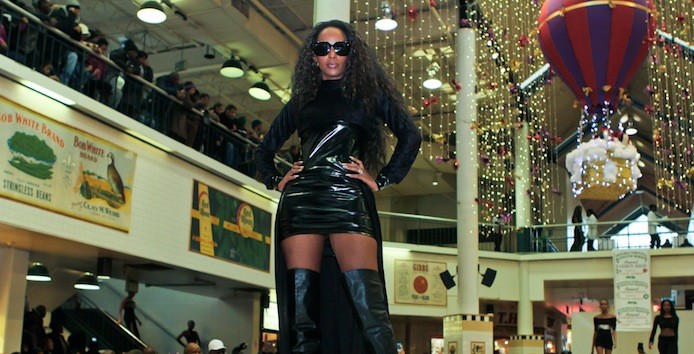

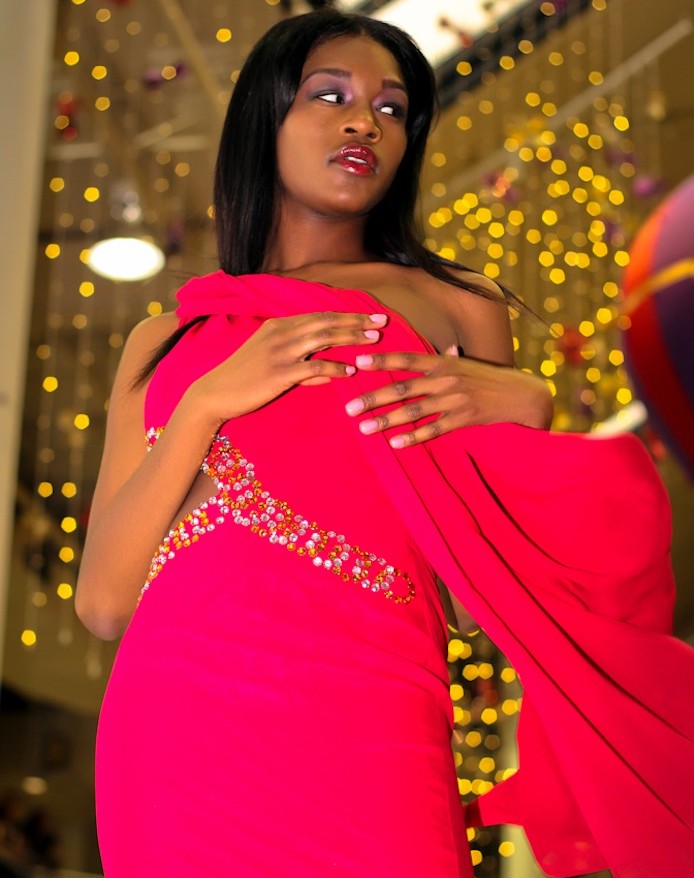
When the final child marched off the catwalk a familiar song started to echo its hi-hat introduction. Mere seconds passed as a train of models gathered at the base of the stairs and allowed the tempo to increase before mounting the runway. What followed were statuesque women leisurely strutting, preened and perfect in tight fabrics that clung to their torsos. As the female models finished their run a natural climax announced itself with the bass growl of Isaac Hayes who asked the crowd, “Who’s the black private dick that’s a sex machine to all the chicks?” And as those words were being considered, a man dressed in a creamsicle zoot suit paused mid catwalk and struck a pose at the exact moment the song screamed, “SHAFT!” and I was hooked.
The first group of models departed the catwalk and a second group was primed, ready to go. These models were clad in long, flowing coats that swept unhindered across the runway. One male model ripped off his suede duster, revealing his muscles that he happily flexed for the snapping cameras. This was quickly followed by a fur clad saxophonist who belted out a mournful solo on her instrument before shedding her jacket. Female models appeared behind her in billowing, gauzy cloth and prowled down the runway. The melody of the saxophone resumed once again, providing a soulful anthem to the remaining models who revealed their bodies with beautiful indifference.

Nighttime outer wear immediately followed and it featured men dressed in traditional smoking jackets dyed the color of skittles. Alternatively, the women sported revealing slips that they wore with an unassuming dignity, parading out in pairs, shifting between one another, chiseled and silent.
The bathing suit segment elicited the loudest responses from the audience who hooted and hollered at the full figured women that stretched the limits of their intentionally immodest swimwear. When the men took the stage they ran in Baywatch formation, laughing as the older ladies in the crowd cat called and grinned at one another with wicked smiles.
The rest of the show passed in a blur. Carefully selected songs sold each segment with a purposeful ease and the choreography responded with outbursts of impromptu performance.
Despite the inevitability of the show’s conclusion, the finale simply appeared, refusing to indicate to the audience that at any point there was a lack of momentum or energy. Models appeared on the runway, rapidly converting the long white stage into a smattering of vibrant colors that bled alien eloquence into the normally drab interior of Lexington Market. With hands clasped, the models departed up the staircase, disappearing into the dressing room above. The onlookers lingered for a few moments; a fight erupted by the exit; the snow converted from sleet to slush; and a fleet of janitors broke out their brooms and began to make big piles of glitter, ribbon, and paper cups.
Silence gave way to soft jazz as the ropes surrounding the runway were dismantled. A Korean vendor took advantage of the lack of security and stepped out onto the catwalk where he proceeded to prance up and down, dancing while imitating a model in full vogue. At one point he partially unzipped his fleece and winked seductively at the photographers who lingered behind, cycling through their pictures. By the time I left Lexington Market the vendor was still gyrating on the runway, spinning undisturbed in the emptiness of the lobby.