
Photo by Baynard Woods
If the desires for food, sex, and shelter are the most basic of our requirements, telling stories is the most human. And we often tell stories about the search for these universals.
Stoop Storytelling, then, is one of Baltimore’s most human institutions. The series is born out of a respect for personal, individual stories that is almost heroic in this age of political posturing and ideology.
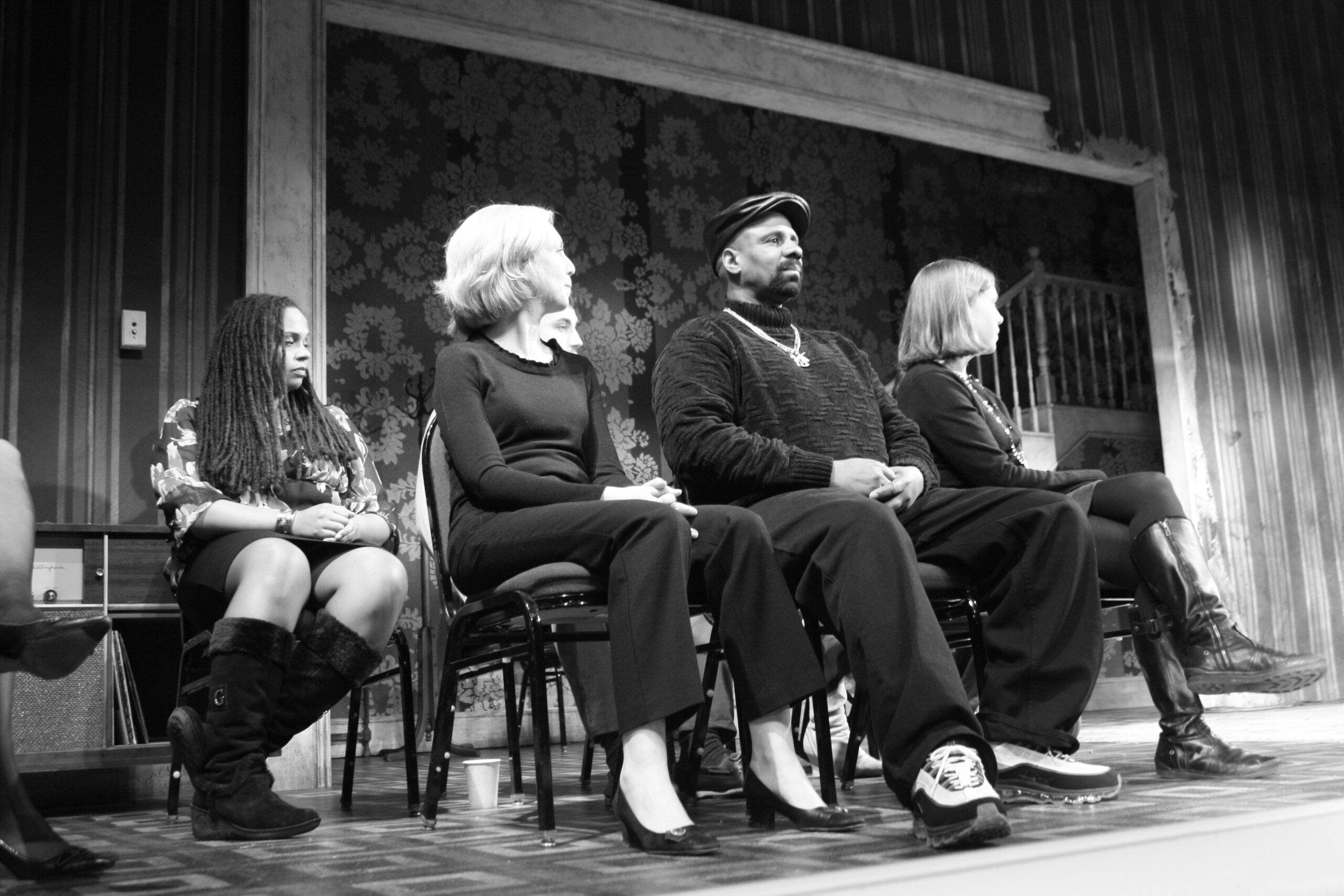
Every Stoop Storytelling event gathers speakers and listeners around a single topic. The February 7th event—put on in conjunction with Earl’s Place and the Creative Alliance— at Center Stage was titled “Gimme Shelter.” The Rolling Stones reference was apt. That song is defined by the utterly personal voice of Merry Clayton.
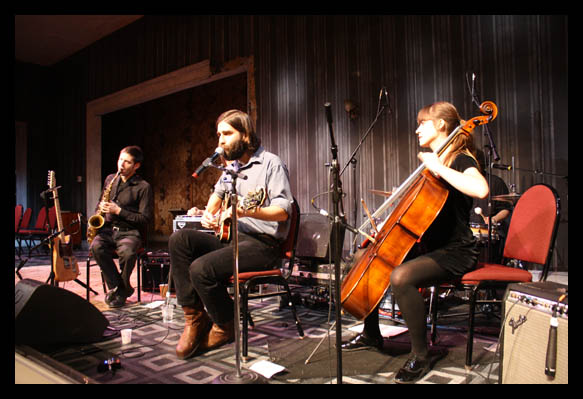
Small Sur, Photo by Baynard Woods
The band Small Sur started out the night, and their quiet, lush, meditative songs set the evening. The location was perfect as well. The stage was set like a tattered old home (from the Center Stage production of “Homecoming”).
Much of the power of Stoop Storytelling comes from its organizers and directors Laura Wexler and Jessica Henkin. They have an interesting dynamic. Henkin works as the special education coordinator at a Baltimore charter school, and Wexler is a writer and the editor of Baltimore Style magazine and their personalities are different and complimentary. They’re like two ideal anchors of the SNL news segment. They’re warm and quirky. Henkin’s introductions, particularly, were hilarious, without being jokey. Bursts of spontaneous free-association, started the night right.
Both Henkin and Wexler believe in the power of personal stories and they let the storytellers shine. “We do it because we’re nosy curious people,” Wexler told me. “We want to know everybody else’s stories. We think stories matter not only for the teller, but also for the listener.”
The first storyteller, a young woman named Meg Adams, told about moving to Antarctica to work on the support staff at the South Pole station. “It was like being at sea but surrounded by 360 degrees of waves of white snow.” She lived in a tent-like structure with a knife, so that she could cut an x in the wall and dive out. “I have faith in that home feeling to exist in the most unlikely places and persist to the ends of the earth.”
Luke Wesby, the next storyteller, told a powerful story of losing and finding home. “I became a drifter,” he said looking sharp in black clothes and sneakers. “I looked in a window one day and I saw a bum, and it was me.”
Wesby told about a crucial long night in an abandoned house. After that he started pulling his life together, and eventually bought a house through Hopkins’ Live Where You Work program. He told this part of the story with such joy that it was infectious. “I’m even happy to get up and go to work,” he laughed.
Julie Hackett, who now works for the U.N. told a story about coming home from kindergarten one day to see a pile of stuff outside her apartment, blue and white tennis shoes, a bowling ball case. “And then I saw it, my favorite…chair.” Her childhood gave her a nomadic spirit as an adult and she has lived and worked all over the world. The story ended when she moved to New York, found the perfect apartment, and was assigned to Nigeria.
In accordance with the Stoop tradition, during the intermission– during which Small Sur played– audience members with relevant stories are asked to put their names in a hat to be selected to talk– for a shorter period than the chosen speakers. This allows everyone, including Henkin and Wexler, to be surprised. All three audience members told stories by turns funny and moving.

Joe Challmes, Photo by Baynard Woods
Henkin introduced the next speaker, Joe Challmes, as a “bad ass. Here’s this pile of shit I’ve been dealt, so I go to the laundry mat and hope people don’t notice I had a big pile of shit on me.”
Challmes, a former Sun reporter, told an amazing story about living in a big apartment that used to be a magistrate’s office with cells, and a big courtroom. His children kept bringing over other kids who were in trouble to let them live in the courtroom. For three or four years, he had eighteen kids living there. “If they’re in my courtroom, they’re not in somebody else’s,” he said.
I knew there was something extraordinarily powerful about the format, but I didn’t understand entirely until a couple nights later when I saw another Stoop production at the Walters. This event was in conjunction with the Maryland Humanities Council, and while the night was still full of great stories, they seemed slightly less powerful because they were attached to an agenda– even one as admirable as facilitating democracy.

Small Sur, Photo by Baynard Woods
The thing all of the storytellers shared at Center Stage was individual and irreducible experience. Perhaps the most moving speaker of the night told a devastating story of sexual abuse, abandonment, homelessness, and addiction. But she told the story like a jazz singer– more Nina Simone than Billy Holliday– there was a joy, ferocity, and an understanding in her voice and her words. I noticed several people wiping away tears only moments after stifling laughter. Tonier Cain had learned that we can change our lives, but we can’t change our stories. They are our grounds; our identities; the context out of which every decision arises.
Wexler was right, stories, like the ones we heard at Center Stage, left everyone perhaps not more enlightened, but certainly more human.
Stoop Storytelling is one of the best things Baltimore has going.
–Baynard Woods