Photos and Story by Baynard Woods
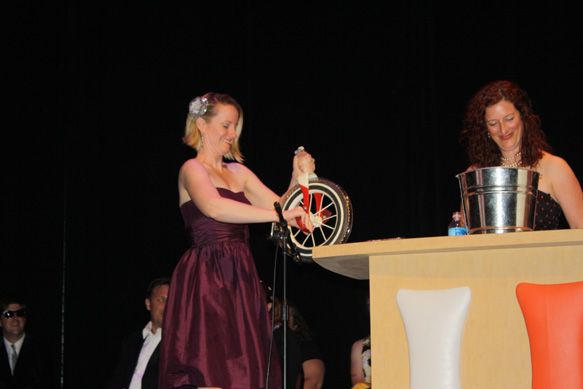
Two twelve packs of Natty-Boh cans, two six packs of root beer bottles, tin-cans and string placed like relics on a blanket in a bowl, a miniature door, which did not lead anywhere but had a regular sized handle and latch, a number of children’s toys, largely of the police car and fire truck variety, a drill, several carabineers, a spray can of pledge, a hair-dryer and a bicycle tire, were crowded together on one end of the table in the center of the conference room at WYPR’s studio on North Charles Street. Jessica Henkin and Laura Wexler, the founders and producers of the Stoop Storytelling Series, stood at the other end of the table looking over a pile of scripts. Two members of the Belvederes were lugging keyboards and amps into the corner. The room was full of the Stoop Radio Players, who were standing around, looking over lines, eating pizza, joking, and contributing to Henkin and Wexler’s discussion of the order of sketches for the old-style radio skits they would be performing live—and for the airwaves—between Stoop’s usual unscripted stories.
“Ok. So, Intro, Wedding in a minute…” Wexler mused, her red curls hanging down over the paper.
“Then maybe these two in the second segment,” said Jessica Henkin pointing at the paper and crinkling her nose. Wexler nodded.
The scripts were originally improvised in a radio studio and later edited down and reworked. “We never could have sat down and written the skit about the changeling. Something that bizarre, had to be improvised,” Wexler explained. “I am not big on the performing but I love the process of it.”
“We’re not going to do any editing now,” Henkin said, turning to grab a slice of pizza.
“That’s like asking me not to breath,” replied Wexler, an editor at Baltimore Style and the author of the book Fire in a Canebrake.
Then, a tall, lanky bundle of excitement with black hair and thick-rimmed glasses, rushed into the room, sorting more scripts he’d been printing in his skateboard-filled office down the hall. It’s Aaron Henkin, a host and co-producer of WYPR’s arts and culture show “The Signal.” He laid the papers on the table and turned to Ron Spencer, who, along with Wexler, would be in charge of using all the objects on the table to produce the show’s sound effects.
“I’ve created a custom window smashing device,” Henkin said, his radio voice resonating over the din. He stooped down to a large plastic container and opened its lid. He arranged two by fours on either side and then crouched under the table and unwrapped a pane of glass. He laid it across the two by fours and closed the top. “I cut a hole there, see,” he said. “And this is a heavy iron pole wrapped in duct-tape.”
Spencer laughed and looked impressed. “I’ve also made us a better bong,” Aaron said.
“We try to have a bong in every show,” Wexler explained.
This is the fourth live radio show that Stoop and the Signal, two powerhouses of storytelling in Baltimore, have put together. In the conference room that Sunday, they had four days to be ready for “The Stoop Says I Do,” this summer’s three night show on marriage.
It’s an especially appropriate topic for the collaboration because everyone involved is wedded to each other in some way or another, which is why it was so much fun to be in that room with them as they rehearsed. Nobody could stop joking.
When Laura met Jessica, she said she didn’t have a very high opinion of improv, but she started to get into it and eventually married Mike Subelsky, the founder of the Baltimore Improv Group. In 2009, when they decided to do radio skits along with live stories, Wexler and Henkin recruited the Stoop Radio players from the Baltimore Improv Group. There have been some changes. At first, Subelsky helped Wexler do the sound effects. “It was stressful. We decided it would be better for the marriage if we didn’t do that together. Now he does our web work,” Wexler explained. “I don’t see how Aaron and Jessica do it sometimes.”
At the Midtown Yacht Club, where my wife Nicole and I met Aaron and Jessica for drinks one night, he agreed that the “Collaboration is like a marriage. You drive each other crazy but you do amazing things you couldn’t otherwise do.”
NPR’s Andrea Seabrook set Aaron and Jessica up on a blind date. At first, Jessica didn’t want to go. “I had a vision of long flowing heavy metal hair—he just sounded so old. And he was a divorcee.”
“Andrea sent a picture, and it was of her with some buff dude.” But they eventually managed to go on a date.
“So here we are married, we have children who have a proliferation of toys and to make this radio show, and for the sound effects, I’m stealing, taking away, and disassembling their toys.”
“We had a lot of trouble with the tricycle,” Jessica added. In one of the skits, called “Groomzilla,” a finicky groom wants to ride a zip cord in a flaming tiger striped suit to burst through the stain glass. Aaron had worked for months on the zip cord sound. He finally affixed a chain to his daughter’s tricycle tire. “She watched while I did it.”
“That’s his favorite sound effect,” Jessica said as Aaron cracked open a peanut. “Because he knows what it costs. Whenever anyone else does it, he can’t hide his disapproval.” Jessica sipped her beer and added, “And I’m the one who does it.”
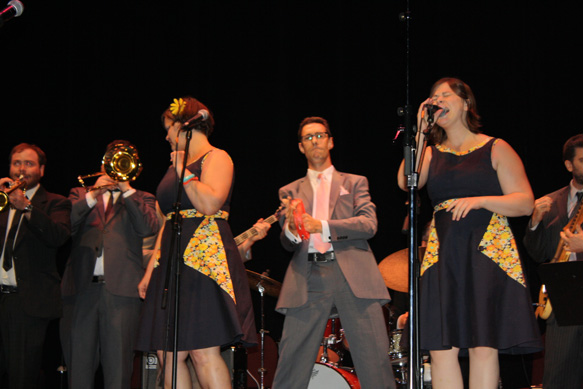
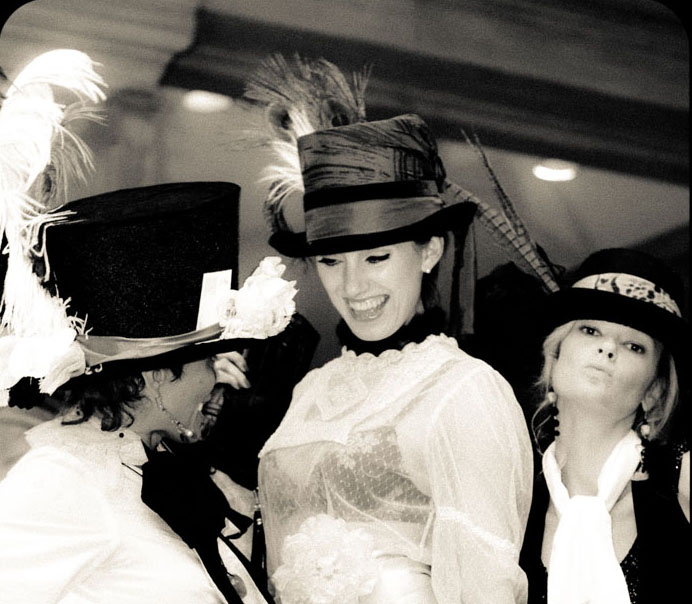
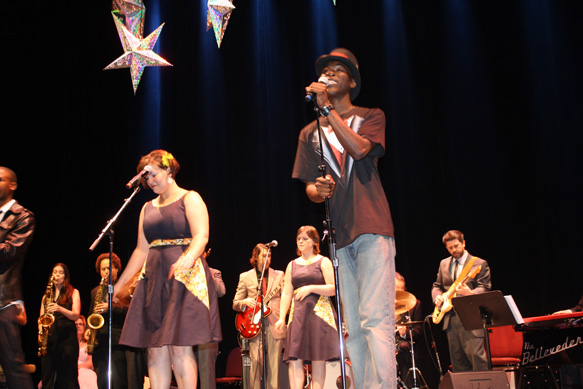
On stage, the cast had even more fun than they did in rehearsal. The Bellevedere’s full band belted out old school soul during the cocktail hour, provided brilliant musical quotes to accompany scenes, and later featured the 5th L who also performed and Aaron Henkin singing the part of Ike Turner and playing a red tambourine. In a gray suit and top-hat, he relished his role as emcee. But everyone relished his or her role. Janet Gilbert composed a Broadway style number that her daughter sang. Michael Harris, Fred Lohr, Heather Moyer, and Catherine Robinson were all hilarious in their different roles. The marriage-themed double-entendres and Baltocentric jabs were delivered with verve and skill.
The German poet Heinrich Heine said, “There is a God: His name is Aristophanes.” All of Aristophanes’ comedies end with a “gamos,” a union, either a wedding or an orgy. And there is something fittingly Aristophanic about “The Stoop Says: I Do.” Like the great Greek playwright, the humor looks upon our marital foibles with a generous grace. Like the unscripted stories they punctuate, the Stoop’s comedic pieces tell us something about what it is like to be alive.
The Stoop Says: I Do” airs on “The Signal” on Friday at 7:00 p.m. and Saturday at 1:00 p.m. this week on WYPR 88.1 and online at stoopstories.org and wypr.org.
Full disclosure: if you look over to the side of your screen, you’ll see that Stoop Storytelling shares a sponsoring partnership with What Weekly. I have personal and professional connections with Wexler and the Henkins.
So I’m not objective, but I’m interested, because this is an event where some of the city’s greatest champions of the story, and of the human voice, come together in a profound way. My bias is that narrative makes us human and is the only way to escape from ideology and group-think, because in a good story, a real story, the voices, the details, and idiosyncrasies cannot be contained by ideas. They are absolute.
Photos and Story by Baynard Woods