By Scott Carlson

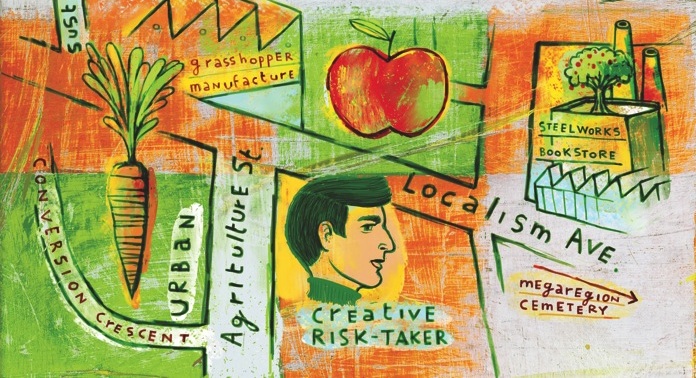
In her book Small, Gritty, and Green, Catherine Tumber argues that the modern localist movement “is little understood and well worth recovering,” as it “could appeal to both liberals and conservatives during our own era of economic upheaval and political crisis.” Illustration by Marco Marella
A couple of years ago, while I was reporting on a redevelopment plan in Buffalo, New York, I met up with Robert Shibley, an architecture professor who had long been interested in a renaissance for his once-great Rust Belt town. Buffalo, along with cities like Utica, Syracuse, and Rochester, had the sort of wonderful, old architecture and infrastructure you can find across upstate New York. We agreed that it was a shame to watch these places crumble in abandonment.
But Shibley foresaw a glorious future. With ample freshwater (including the nearby Great Lakes), rich agricultural land, and a cool climate, upstate New York was well positioned in a hot, thirsty, and oil-starved future. It was almost a Manifest Destiny. “It is our ecological responsibility to grow here,” he said.
Catherine Tumber would have agreed. Her excellent new book, Small, Gritty, and Green: The Promise of America’s Smaller Industrial Cities in a Low-Carbon World, finds potential in many busted and booming-again cities in the Northeast and Midwest, cities like Flint, Michigan; Muncie, Indiana; Peoria, Illinois; and Youngstown, Ohio. She could have swept south and also included Hagerstown; York, Pennsylvania; and maybe even Richmond, Virginia; and Greensboro, North Carolina, and still stuck to her thesis. Even Baltimore—which might be larger but has so far avoided unchecked sprawl—may fit into Tumber’s vision. These places, she writes, are both big enough and small enough to manage a coming societal transition, in which people may have to live on constrained oil supplies and rely more on local networks for food and other goods.
Continue reading this story …